Roanoke Schools Get Virginia’s First K-12 Solar Microgrid
- Emergency & Local Government Microgrids News
Marin Holt
- 0
- 7 minutes read
- Virginia VDEM awarded $450,000 to Roanoke City Public Schools from the 2026 Shelter Upgrade Assistance Fund
- Developer Secure Solar Futures contributes $2.1 million; total $2.55 million with no upfront cost to schools
- Patrick Henry and William Fleming high schools each receive 1 MW solar and 4 MWh battery storage
- Virginia's first solar-powered microgrid at any K-12 public school; covers 46.1% of annual electricity use
- Project avoids $60.2 million in electricity and roof costs over 35 years; construction completes end of 2026
Roanoke City Public Schools will build Virginia’s first solar-powered microgrid at a K-12 school, using a $450,000 state grant and $2.1 million in private investment to keep two high schools operational as emergency shelters during power outages. Construction finishes by end of 2026.
What Is Being Built
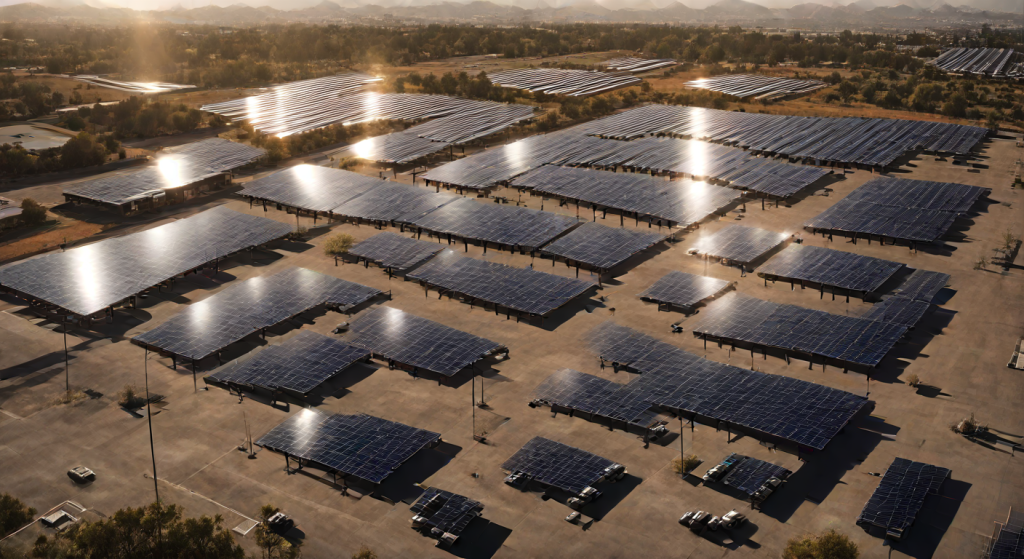
Patrick Henry High School and William Fleming High School will each receive solar arrays with battery storage systems. The combined installation will cover 46.1% of annual electricity consumption at both campuses. Secure Solar Futures, a Virginia-based solar developer, is financing and building the $2.55 million project. The school district pays zero upfront cost.
Both schools hold official Virginia Department of Emergency Management (VDEM) designations as public emergency shelters. During storms, ice events, or extended grid failures, residents report to these facilities for heated or cooled shelter, device charging, and emergency coordination. Without reliable power, the shelters become unusable precisely when the community needs them most.
Why This Matters
Emergency shelters that depend on grid power fail at the worst possible moment. Diesel generators provide a stopgap, but they require fuel deliveries that become unreliable during severe weather. Solar microgrids with battery storage generate and store power on-site, eliminating fuel logistics during the critical first hours and days of an emergency.
The Roanoke project demonstrates a financing model that other school districts and municipalities will study. VDEM provided the $450,000 grant. Secure Solar Futures invested $2.1 million through a solar power purchase agreement, meaning the developer owns and maintains the system while the schools buy power at a fixed rate below retail. City National Bank and the Virginia Clean Energy Innovation Bank provided additional financing. The district’s projected savings over 35 years reach $60.2 million in avoided electricity costs and roof replacement expenses.
Implementation Details
VDEM’s grant program targets facilities with existing emergency shelter designations, ensuring microgrid investments protect the highest-value community assets. The Virginia Department of Energy supported the project through its clean energy programs.
Construction begins in 2026 with completion targeted by year-end. The microgrid design includes islanding capability: when the grid goes down, the system disconnects and operates independently, maintaining power to critical shelter functions including HVAC, lighting, refrigeration, and communications.
Roanoke’s approach solves two problems simultaneously. During normal operations, the solar arrays reduce electricity costs for a school district facing tight budgets. During emergencies, the same infrastructure keeps shelters open. That dual-use value proposition makes the economics work without requiring the school district to spend a dollar.
Source: WSLS 10 News
Critical Analysis
Each school’s 1 MW solar inverter must meet IEEE 1547-2018 Section 6.4 harmonic limits at the distribution PCC — for a school feeder with a typical ISC/IL ratio of 20–50, IEEE 519-2022 Table 2 limits TDD to 8% and 5th harmonic current to 7%. Combined 2 MW of solar generation at Patrick Henry and William Fleming serves 46.1% of annual school electricity consumption, creating midday reverse power flow on the Roanoke City distribution feeder.
5-Year Projection
During the 5-year outlook, capitalized Solar ventures will drastically compress technology iteration cycles, demanding continuous utility-level adaptations to accommodate high-velocity product launches.
Critical Perspective
Virginia’s £450,000 grant and £2.1 million in developer financing will cover 46.1% of annual electricity consumption at both Roanoke campuses — a meaningful offset, but structured as a long-term services agreement whose total ratepayer cost over the contract horizon is not stated. Virginia’s emergency shelter designation requires 72-hour autonomous operation; at 4 MWh per site, each system can power roughly 55 kW continuously — less than the load of a single HVAC unit serving a gymnasium designated as a shelter during a December ice storm. Similar first-in-state school microgrid projects — Maryland’s 2021 Cecil County installation and New Jersey’s NJBPU school resilience programme — took an average of 20 months from award to energisation against projected 10–12 month timelines, largely due to utility coordination requirements. This project is described as Virginia’s first K-12 microgrid for emergency shelters; the question is whether ‘first’ means the standard has been proven, or that the interconnection and operational protocols are still being written.