Virginia Awards $450K for Solar Microgrids
- Emergency & Local Government Microgrids News
Marin Holt
- 0
- 6 minutes read
- Virginia VDEM Shelter Upgrade Assistance Fund awarded $450,000 to Roanoke City Public Schools
- Secure Solar Futures contributes $2.1 million; $2.55 million total with no upfront school district cost
- Each school (Patrick Henry HS, William Fleming HS) receives 1 MW solar and 4 MWh battery storage
- Combined 2 MW solar and 8 MWh storage covers 46.1% of annual electricity at both campuses
- 35-year power purchase agreement avoids $60.2 million in electricity and roof costs
The Virginia Department of Emergency Management awarded $450,000 in February 2026 to Roanoke City Public Schools to install solar-powered microgrids at two high schools designated as emergency shelters. Developer Secure Solar Futures contributes $2.1 million, making the total project cost $2.55 million with no upfront cost to the school division.
What Is Being Built
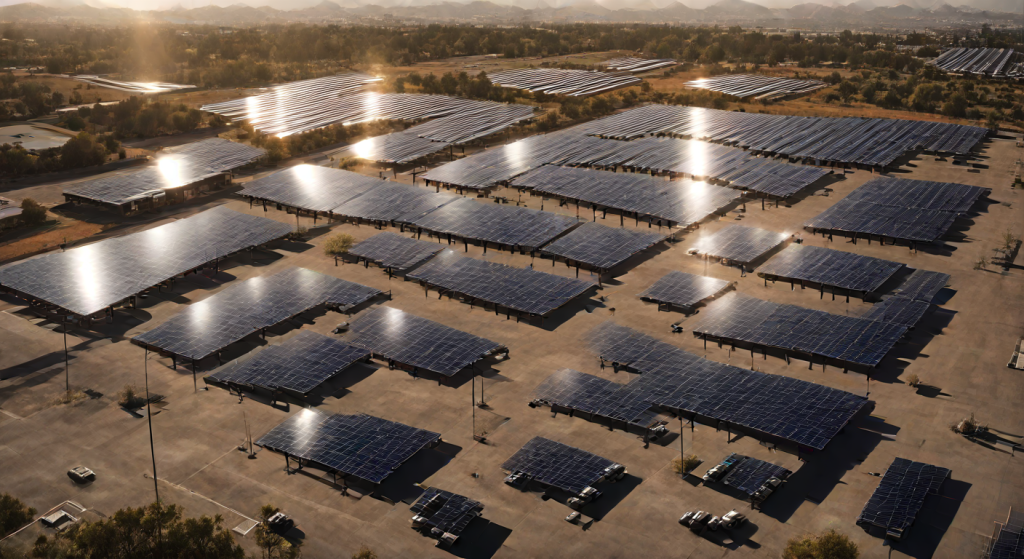
Patrick Henry High School and William Fleming High School each receive 1 MW of solar capacity and 4 MWh of battery storage. The systems connect to a microgrid controller that allows each school to operate independently from the grid during outages. Combined, the project adds 2 MW of solar and 8 MWh of storage across both sites. Roanoke City Public Schools already operates 10.1 MW of solar across 32 locations; this is its first microgrid configuration and Virginia’s first solar-powered microgrid at any K-12 public school. The solar arrays cover 46.1% of annual power usage at both facilities. Financing comes from City National Bank, the Virginia Clean Energy Innovation Bank, and The Coalfield Solar Fund, backed by Intuit.
Why This Matters
Public schools serve as official emergency shelters in most jurisdictions, yet most lack backup power beyond a diesel generator with limited fuel supply. When the grid fails during a hurricane, ice storm, or extended heat event, a school without islanding capability cannot function as a shelter for long. The state grant provides $450,000; the developer recovers costs through power purchase agreements and grid services revenue over the 35-year project life. Total avoided costs, electricity bills plus deferred roof repairs and replacements, project to $60.2 million over 35 years. This model is replicable for other school divisions seeking to convert emergency shelter designations into functional resilient facilities.
Implementation Details
The VDEM grant comes from the 2026 Shelter Upgrade Assistance Fund, a Virginia program designed to harden emergency shelter infrastructure. Project completion is targeted for end of 2026. Secure Solar Futures specializes in solar-as-a-service models for Virginia public institutions, eliminating public procurement of capital equipment. The project includes roof-mounted solar on both high schools with battery storage providing backup power for critical loads including lighting, HVAC, communications, and medical equipment during grid outages.
Critical Analysis
Each 1 MW solar array with 4 MWh BESS at Patrick Henry and William Fleming High Schools operates on Appalachian Power 12.47 kV feeders where ISC/IL ratios are typically below 20, placing these inverters under IEEE 519-2022 Table 2 strictest tier: 4% h<11 and 5% TDD. Two 1 MW solar systems (2 MW aggregate) represent modest renewable addition on Appalachian Power Roanoke distribution network, but school-feeder placement on lightly loaded circuits creates voltage rise risk during midday low-load periods.
5-Year Projection
During the 5-year outlook, capitalized Solar ventures will drastically compress technology iteration cycles, demanding continuous utility-level adaptations to accommodate high-velocity product launches.
Critical Perspective
The $450,000 state grant covers 18% of the $2.55 million project cost, with Secure Solar Futures financing the remaining $2.1 million through an energy services agreement whose implicit electricity rate the announcement does not disclose. At 4 MWh of storage per campus, each system can sustain roughly 50-55 kW of average load — adequate for lighting and communications, but below the HVAC demand that makes a building functional as a winter emergency shelter. Public school solar-plus-storage projects structured as energy services agreements in Virginia and comparable mid-Atlantic states have averaged 14-18 months from contract signing to energization, putting this project’s ‘end of 2026’ timeline at the edge of what is achievable without utility interconnection delays. The question emergency management planners should be asking: has the system been sized and tested for the 72-hour winter outage scenario, or for the summer peak-shaving case that makes the economics pencil out?