Power Factor Penalties Cost Industrial Facilities Thousands
- Analysis Power Factor Power Quality
Marin Holt
- 0
- 8 minutes read
- Most U.S. utilities impose power factor requirements on commercial and industrial customers drawing 300 kW or more, typically requiring 0.90 or above
- Facilities below the threshold pay monthly penalties calculated as a percentage of their demand charge, commonly ranging from 1 to 3 percent per 0.01 power factor unit below threshold
- Motors, transformers, and variable frequency drives all generate lagging reactive power, with food processing, water treatment, and plastics manufacturing commonly operating between 0.75 and 0.88 without correction
- Utility kVA billing structures charge directly for apparent power rather than real power, effectively penalizing poor power factor in every billing period rather than as a separate line item
- A facility with 0.82 power factor drawing 300 kW also draws 70 kVAR of reactive power, requiring the utility to provision 30 percent more conductor and transformer capacity than the load's productive work demands
Most U.S. utilities impose power factor requirements on commercial and industrial customers drawing 300 kW or more. Facilities that fall below the threshold — typically 0.90 — pay monthly penalties calculated as a percentage of their demand charge. At one production facility, an 82% power factor triggered $4,200 per month in penalties starting January 2025. A 75 kVAR capacitor bank costing $18,000 eliminated the penalty in 4.3 months.
What Power Factor Measures
Power factor is the ratio of real power (kW, which does actual work) to apparent power (kVA, which the utility must supply). A facility with a power factor of 0.85 draws 15% more current from the grid than its productive load requires. That excess current, called reactive power, heats conductors, stresses transformers, and reduces the capacity available to other customers. Utilities charge for this inefficiency through power factor penalties or by billing on kVA rather than kW demand.
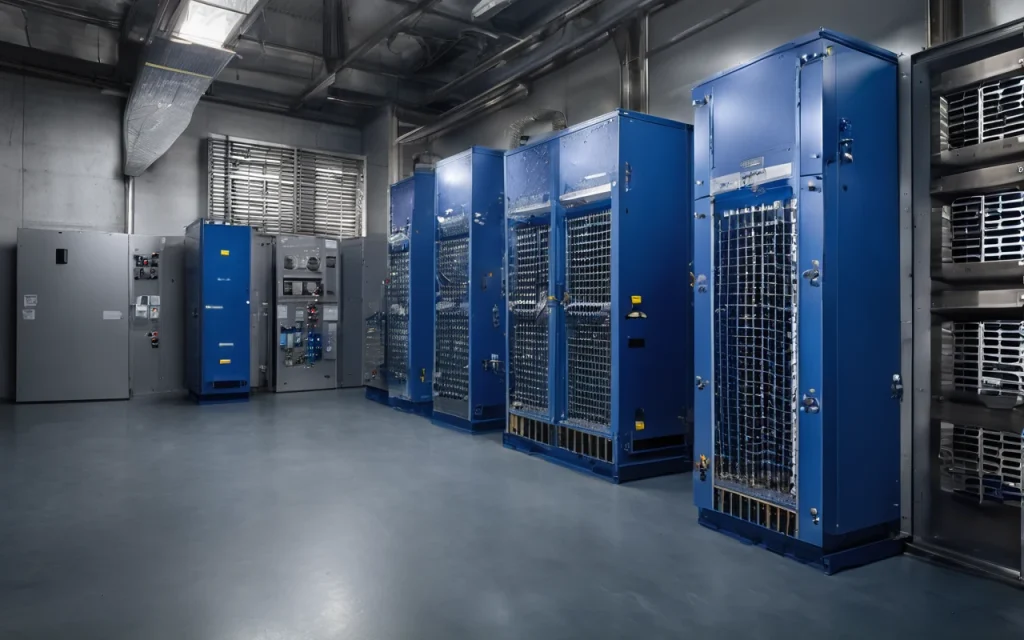
Motors, transformers, and variable frequency drives all generate lagging reactive power. Facilities with heavy motor loads — pumps, compressors, HVAC, conveyor systems — carry the lowest natural power factors. Food processing, water treatment, plastics, and textile manufacturing commonly operate between 0.75 and 0.88 without correction.
How Penalties Are Structured
Utility tariffs vary, but most apply penalties in one of two ways. The first method adds a percentage surcharge to the demand charge for each point below the threshold. A facility 10 points below 0.90 may pay a 10% to 15% surcharge on its entire demand charge for the month. The second method bills on kVA instead of kW demand, effectively penalizing low power factor by charging on the full apparent power drawn. Penalties of 10% to 30% of the demand portion are common. For a facility with $30,000/month in demand charges, that represents $3,000 to $9,000 in monthly penalty exposure.
Capacitor Bank Correction
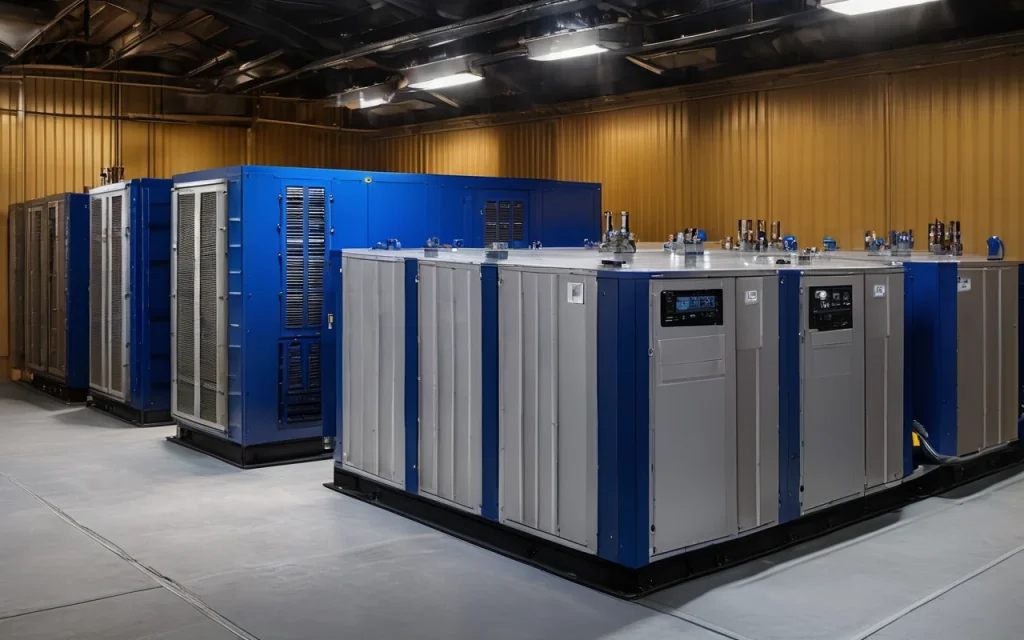
Fixed capacitor banks supply leading reactive power that offsets the lagging reactive draw of motors and transformers. They install at the main service entrance or at individual motor control centers. Most utilities require facilities to target 0.95 power factor, not just 0.90, to maintain a safety margin as loads vary.
Capacitor banks are sized in kVAR increments — typically 50 kVAR or 100 kVAR units. The required kVAR capacity depends on current power factor, target power factor, and facility demand. A facility running 1,000 kW at 0.82 power factor needs approximately 400 kVAR of capacitor bank capacity to reach 0.95.
Automatic capacitor banks switch capacitor steps in and out based on real-time reactive power measurements. They prevent over-correction during light-load periods, which causes leading power factor and a different set of problems. Facilities with variable loads need automatic systems; fixed banks suit operations with consistent load profiles.
Before Installing: The Power Quality Study
Capacitor banks interact with harmonic distortion. Facilities with significant nonlinear loads — variable frequency drives, rectifiers, arc furnaces — produce harmonics that capacitors amplify through resonance. Installing fixed capacitors without a harmonic study first risks damaging both the capacitor bank and the facility’s electrical equipment. The harmonic study costs $5,000 to $15,000. Replacing failed capacitors and downstream equipment costs far more.
The correct sequence: power quality survey, harmonic analysis, capacitor sizing, then installation. Detuned reactor-capacitor combinations or active filters are the right solution when harmonics exceed IEEE 519 limits. The payback on correction remains fast — typically under 12 months — but only with the right equipment selection.
Source: Power Protection Products, Inc.; Power Factor Correction Analysis 2026
Critical Analysis
Power factor penalties emerge from the fundamental relationship between real power (kW), reactive power (kVAR), and apparent power (kVA). Low power factor increases apparent power demand on distribution infrastructure, consuming transformer and feeder capacity without delivering useful work.
5-Year Projection
Over the next 5 years, the deployment of Power Factor Correction will shift from an isolated engineering challenge to a standard operational baseline, driving grid modernization.
Critical Perspective
The $4,200 finding is the study’s headline, but the methodology note constrains its applicability: transmission expansion is treated as exogenous, which means interconnection constraints are not modelled. Comparable analyses have found that modelled projections diverge from actual deployment outcomes by 20–30% when queue delays are incorporated. The study’s baseline assumes policy continuity over a 10-year horizon — an assumption that three recent legislative cycles suggest is optimistic. The question energy professionals should be asking: what does the sensitivity analysis show when interconnection timelines extend by 24 months?