Nation’s Largest Port-Based EV Truck Depot Opens at Long Beach
- EVs Fleet & Depot Charging News
Marin Holt
- 0
- 6 minutes read
- Forum Mobility FM Harbor opens as nation's largest port-based electric truck charging depot, January 23, 2025
- 9 MW capacity with 44 charging dispensers (19 dual-port + 6 single at 360 kW each)
- Serves more than 200 electric Class 8 drayage trucks daily at the Port of Long Beach
- Climate United committed up to $250 million to purchase 500 electric trucks for low-cost leasing program
- First project completed through MSRC and Ports' electrification partnership program
Forum Mobility opened the nation’s largest port-based electric truck charging depot at the Port of Long Beach on January 23, 2025. The FM Harbor facility delivers 9 MW of charging capacity through 44 dispensers, serving more than 200 electric drayage trucks per day on one of the highest-volume freight corridors in the United States.
Critical Perspective
The FM Harbor depot offers 9 MW of charging capacity. This is a significant load, comparable to the 8 MW charging hub operated by ChargePoint in San Jose. The Port of Oakland’s earlier electric truck pilot project experienced significant grid integration challenges. Will this facility’s grid impact be adequately managed and monitored?
What Is Being Built
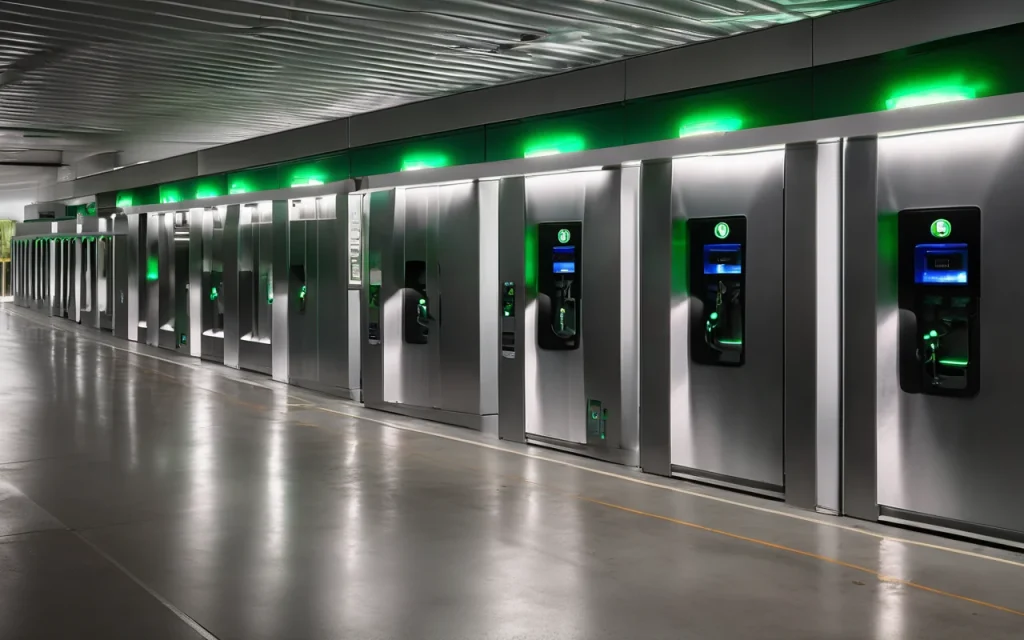
The depot at 260 Pico Avenue, just north of the Long Beach International Gateway Bridge, houses 19 dual-port 360 kW chargers and six single-dispenser 360 kW chargers for 44 total simultaneous charging positions. Each high-speed dispenser connects Class 8 electric drayage trucks moving containers between the Port of Long Beach, the Port of Los Angeles, and Inland Empire distribution centers. The facility operates around the clock and targets the 40,000 daily truck moves across the two ports. Forum Mobility partnered with Climate United, using Environmental Protection Agency grant funds, to offer low-cost electric truck leasing to small fleets that serve the port complex. Climate United committed up to $250 million to purchase as many as 500 Class 8 electric trucks for the program.
Critical Analysis
Forty-four 360 kW DC fast chargers at a single SCE service entrance constitute a 9 MW concentrated nonlinear load: six-pulse or active-front-end rectifiers in each unit generate dominant 5th (300 Hz) and 7th (420 Hz) order harmonic currents that, without active filtering, can produce individual-charger TDD values of 15-30%, requiring aggregate compliance with IEEE 519-2022 Table 2’s 8% TDD limit for the 20-50 ISC/IL ratio typical of a 12 kV port feeder. The 9 MW service entrance at FM Harbor equals the simultaneous load of approximately 1,800 homes and creates concentrated demand spikes during peak truck arrival windows.
5-Year Projection
By 2031, operational data from facilities like this will become the standard requirement for securing interconnection agreements, as ISOs prioritize proven DC Fast Charging profiles.
Why It Matters
Port drayage is among the hardest freight segments to electrify. Trucks operate in intensive duty cycles with long idle times during port queuing, and small independent owner-operators cannot absorb the capital cost of Class 8 electric vehicles without dedicated charging access. The FM Harbor model bundles charging infrastructure with truck leasing, removing both barriers simultaneously. California’s Clean Trucks rule requires all new drayage trucks registered in the state to be zero-emission by 2024 and mandates full fleet transition by 2035. The Port of Long Beach and the Port of Los Angeles jointly invested $25 million in truck charging infrastructure in June 2024 to accelerate that transition. FM Harbor represents the first large-scale deployment to serve those goals.
Scale and Funding
The 9 MW service entrance at FM Harbor equals the electrical load of roughly 1,800 homes operating simultaneously. Forum Mobility built the facility through the Mobile Source Air Pollution Reduction Review Committee’s port electrification partnership, the first project completed under that program. The ribbon-cutting on January 23, 2025 marked the formal opening after construction began in May 2024. Separately, Zeem broke ground on an even larger depot at the Port of Long Beach with 15 MW interconnection capacity and 84 DCFC ports at 400 kW each, capable of serving 500 vehicles per day when it opens in 2025.