The Broader AC vs DC Distribution Debate: Why the Solid-State Transformer Industry Sits at the Pivot Point

The Thomas Edison versus George Westinghouse “war of currents” in the 1880s and 1890s settled the question of whether US electricity distribution would use alternating current (AC) or direct current (DC). Edison’s DC architecture lost; Westinghouse’s AC architecture won decisively because AC could be transformed efficiently to higher voltages for long-distance transmission, then transformed back to lower voltages for end-use. The argument has remained settled for approximately 140 years. Three loads in 2024-2026 — AI data centers, EV charging depots, utility-scale battery storage — are credible challenges to that settlement, and the solid-state transformer (SST) industry sits at the technical pivot point.
The case for DC distribution at facility scale is stronger now than at any point since the 1890s. Modern semiconductor power electronics can transform DC voltages with the same efficiency that conventional iron-core transformers transform AC voltages — and at substantially smaller size, weight, and material content. Large modern loads are increasingly natively DC: solar PV output is DC, battery storage is DC, EV charging delivers DC, AI accelerator cards consume DC. Distributing as AC and then converting to DC at multiple stages within a facility imposes 10 to 30 percent total conversion losses across the chain.
The case against DC distribution at scale is also serious. The installed AC distribution infrastructure represents trillions of dollars of capital that cannot be replaced overnight. AC has the inherent zero-crossing property that simplifies circuit breaker design — interrupting AC fault current is much easier than interrupting DC fault current. AC standards (50 Hz in Europe and Asia, 60 Hz in the Americas) provide synchronization references that DC distribution must replicate through other mechanisms. The power-electronics components required for DC distribution at scale are still maturing and remain materially more expensive per kVA than AC equivalents.
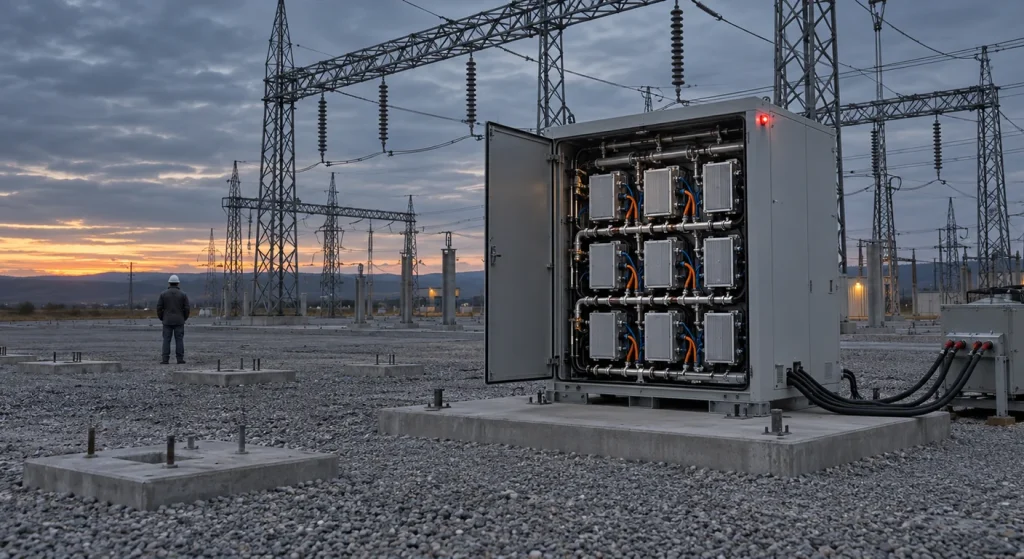
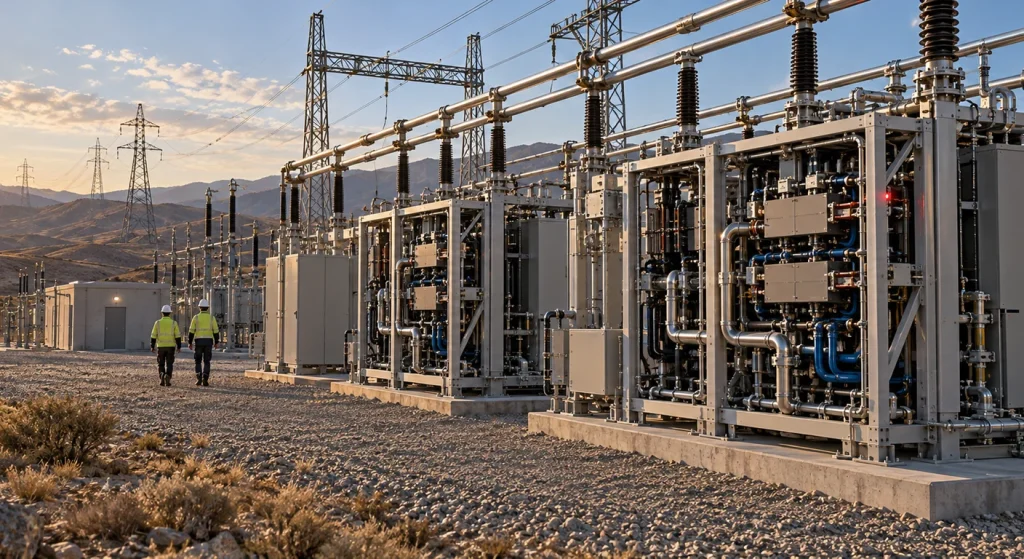
The compromise architecture emerging in 2025-2026 is hybrid AC-DC distribution at facility scale. Medium-voltage AC remains the dominant utility-to-facility interface. The facility-side conversion to DC happens at the medium-voltage to low-voltage boundary — the location an SST naturally occupies. The DC distribution backbone within the facility serves loads that benefit from DC (AI accelerator racks, EV chargers, battery storage). AC distribution within the facility serves loads that benefit from AC (motors, conventional lighting, HVAC equipment).
The strategic implication for the SST industry is that the hybrid AC-DC future is the SST industry’s home. SSTs are the architectural element that makes the hybrid feasible at commercial scale. Whether the global electrical distribution architecture eventually rebalances back toward DC at scales beyond the facility level — at the distribution-feeder level, at the transmission level — is the question that determines whether the SST industry remains a niche solving specific load problems, or becomes a foundational technology displacing iron-core transformers at gigawatt scale across the global grid.
Why It Matters
For infrastructure strategists, three 2024-2026 loads, AI data centers, EV charging depots, and utility-scale storage, are reopening the AC-versus-DC distribution question that stayed settled for 140 years since the war of currents. That reframes the SST from an efficiency upgrade into the interface technology at a potential architectural inflection point, which is a far larger stake than a transformer replacement.
Critical Perspective
Editorial correction: This post is part of MGRID’s Solid-State Transformer industry coverage. As of May 2026, that body of work systematically framed manufacturer announcements, funding rounds, and laboratory demonstrations as commercial deployments. The reality is that field-deployed commercial-class SST in revenue service globally is measured in single digits, and almost every product cited in this series is at “announced” or “funded” stage, not “operational.” Readers should treat the specific claims in this post against the standards documented in our SST Industry Reality Check (the per-claim audit table maps marketing language to verifiable deployment status). The corrective article is the canonical reference for SST industry reality; this post remains published with its original framing so the editorial drift is traceable.