Delta Electronics Showcases 800 VDC Solid-State Transformer Power Solutions at OCP Global Summit 2025

- Delta OCP Global Summit 2025 booth #B51, San Jose CA October 14-16
- Medium-voltage SST converts MV AC directly to 800 VDC for NVIDIA AI Factory spec
- 90 kW HVDC/DC Power Shelf: 800 VDC to 50 VDC, 98% efficiency, 180% transient response
- 1.1 MW rack-scale capability consistent with NVIDIA reference architecture
- First Delta public commitment to medium-voltage SST product line
Delta Electronics presented its 800-volt DC power solutions stack — including a medium-voltage solid-state transformer (SST), high-voltage DC distribution busway, and a 90-kilowatt rack power shelf — at the OpenCompute Project (OCP) Global Summit in San Jose, California, October 14 to 16, 2025. The product set is Delta’s formal entry into the AI data center SST competition and was developed in close collaboration with NVIDIA against the company’s 800 VDC AI Factory specification.
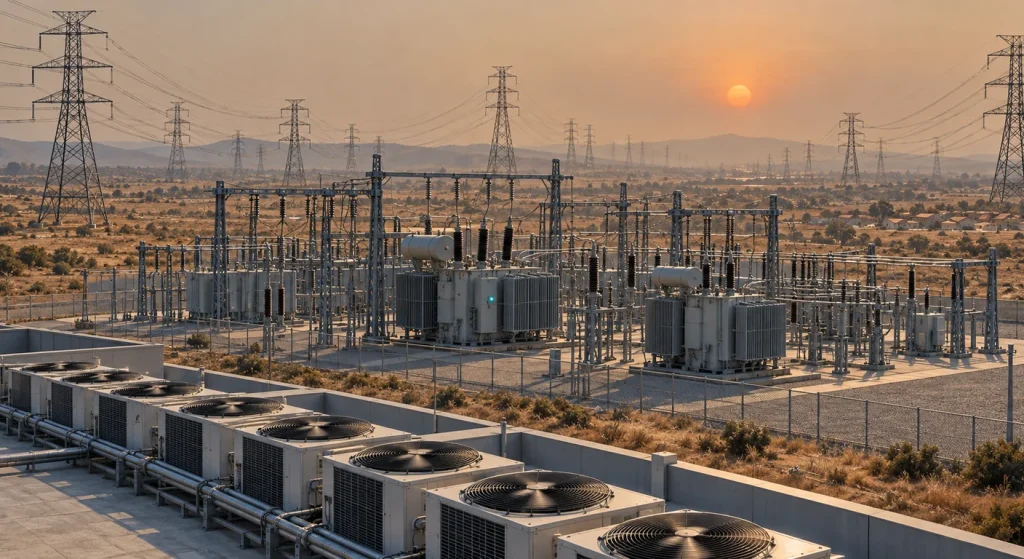
The Delta SST converts medium-voltage utility AC input directly to 800 VDC, eliminating the multiple intermediate conversion stages used in conventional 480-volt AC data-center distribution architectures. Delta positions the SST as the head end of a complete 800 VDC distribution stack: the SST feeds the 800 VDC busway, which delivers power to rack power shelves, which step down to the 50-volt DC bus used by NVIDIA accelerator cards.
The 90-kilowatt high-voltage DC power shelf occupies a single 19-inch, 1-rack-unit chassis and converts 800 VDC to 50 VDC at up to 98 percent efficiency with a 180 percent transient-response margin. The transient-response number is significant. AI accelerator workloads create large, rapid power swings that conventional 50/60 Hz transformer infrastructure cannot follow. The combination of SST and high-voltage DC shelf at the rack input is purpose-built to absorb those swings without propagating them upstream to the utility.
Delta has been a long-standing supplier of data center power components but had not previously committed to medium-voltage SST product development. The OCP Summit announcement is the first time the company has placed an SST in its public product roadmap. The 1.1-megawatt rack-scale capability Delta demonstrated is consistent with NVIDIA’s reference architecture for next-generation AI Factory deployments.
The OCP Summit also surfaced parallel SST announcements from DG Matrix (the first commercially available multi-port SST, shipped February 2026), SolarEdge and Infineon (modular 2-5 megawatt SST partnership announced November 5-6, 2025), and Amperesand (30 megawatts of commercial MV-SST shipments targeted for 2026). The SST has moved from research topic to data center product line within a 12-month window centered on the 2025 OCP cycle.
Why It Matters
US hyperscale data center buyers evaluating Delta’s SST stack should require disclosure of US-content fraction across the silicon carbide, magnetics, and packaging supply chain, and should request a named-deployment customer reference. Internal supply-chain-security reviews may impose constraints that affect total cost of ownership beyond the headline unit price.
Critical Perspective
Delta Electronics’ formal entry into AI data center SSTs adds another credible vendor to a market that already has more named competitors than shipped commercial deployments. Delta is one of the larger Asia-Pacific power-electronics OEMs and has the manufacturing scale to compete with Hitachi and ABB, which makes its OCP Global Summit positioning a serious competitive signal. The product set presented (medium-voltage SST plus 800 VDC busway plus 90 kW rack power shelf) is a complete stack from utility input to compute load, which differentiates Delta from vendors shipping only the SST module. The execution risk is supply-chain rather than technical: Delta’s component sourcing is more Asia-concentrated than US hyperscale buyers may prefer, particularly under BIS export controls on power semiconductors. Coverage that frames Delta as a tier-1 SST vendor on the basis of conference presence overstates the operational maturity; the relevant test is named hyperscale customer deployments, which Delta has not yet publicly disclosed.