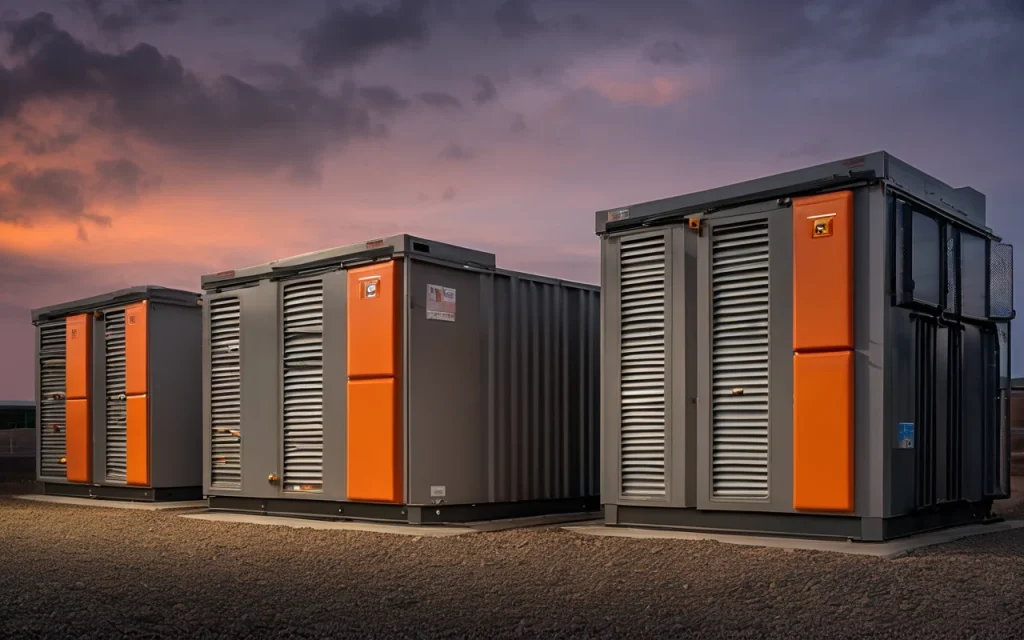
C&I Battery Storage Costs Drop 40%
- Demand Charge Reduction Energy Storage News
Marin Holt
- 0
- 8 minutes read
- Commercial LFP battery storage costs fell 40% from 2022 to 2026, reaching $180-$300/kWh installed
- NREL ATB 2024 tracks a 600 kW / 4-hour system at $199/kWh for the battery pack
- Demand charges represent 30-50% of commercial electricity bills, based on single 15-minute peak interval
- A 500 kWh system shaving 200 kW of peak demand saves $48,000-$60,000 annually at $20-$25/kW rates
- Federal ITC covers 30% of installed costs, reducing effective payback to 3-5 years for sites with demand charges above $15/kW
Commercial and industrial battery storage system costs dropped 40% between 2022 and 2026, pushing installed prices for containerized systems to $180-$300 per kWh. That cost decline crossed the threshold where peak shaving alone justifies the investment for the five million U.S. commercial customers paying demand charges above $15 per kW, according to NREL analysis.
The Demand Charge Problem
Demand charges now account for 30% to 50% of commercial electricity bills. Utilities set these charges based on a facility’s single highest 15-minute power draw during the billing period. One production surge, one simultaneous HVAC startup, or one EV fast-charging session sets the demand peak for the entire month. A [50 kW](/?p=4929) EV charger alone adds approximately $1,500 per month in demand charges at a $30/kW rate.
Battery systems eliminate these spikes. A 500 kWh system shaving 200 kW of peak demand saves $48,000 to $60,000 annually at typical commercial rates of $20-$25 per kW. The battery charges during off-peak hours and automatically discharges when facility load approaches preset thresholds, keeping the utility meter below the demand tier that triggers higher charges.
What Changed in 2026
Lithium iron phosphate (LFP) battery pack costs, which represent 50-60% of total system costs, drove the decline. The remaining balance of system, power conversion equipment, and installation labor fell at slower rates. A standard 600 kW commercial installation with four-hour duration now costs roughly $219 per kWh in the United States, compared to $73/kWh in China and $177/kWh in Europe.
The federal Investment Tax Credit covers 30% of installed costs for qualifying systems, pushing effective payback periods to 3-5 years for facilities with demand charges above $15/kW. Fixed operations and maintenance runs approximately 2.5% of capital cost annually, with round-trip efficiency at 85%.
Utility programs accelerated adoption. Xcel Energy launched its Empower Resiliency program in Minnesota, the state’s first utility-owned microgrid offering for commercial customers. Xcel installs, owns, and maintains battery storage, solar, and backup generators at customer sites. Customers pay over time with no upfront capital requirement. Water treatment plants, hospitals, manufacturing facilities, and schools qualify for the program.
Where Batteries Work and Where They Do Not
Peak shaving delivers the strongest returns for facilities with narrow, spiky load profiles: warehouses with dock door operations, cold storage with compressor cycling, retail buildings with morning HVAC ramp-ups, and facilities adding EV charging. These loads spike briefly and predictably, requiring shorter battery discharge durations to flatten the peak.
Flat, continuous loads are harder. A 24/7 manufacturing line running at steady-state draws consistent power with few peaks to shave. For these facilities, time-of-use arbitrage, charging batteries at $0.08/kWh overnight and discharging during $0.35/kWh peak windows, provides the primary savings mechanism instead of demand charge reduction.
The C&I storage market installed 195 MW in 2022 and is forecast to reach 1.4 GW annually by 2030. The gap between residential adoption (593 MW in 2022) and commercial deployment reflects the complexity of commercial projects: custom load analysis, utility interconnection agreements, and longer procurement cycles that residential systems avoid. The 40% cost decline narrows, but does not eliminate, that adoption gap.
Sources: Dominion Electric, Energy Storage News
Critical Analysis
Bidirectional PCS inverters in 500 kWh to 600 kW LFP battery systems produce characteristic 5th and 7th order harmonic currents during charge and discharge modes; at $219/kWh installed cost these systems are large enough to drive TDD violations at weak commercial PCCs. Widespread 200-500 kWh peak-shaving battery deployment creates coordinated off-peak charging ramps: simultaneous LFP charging at 11 PM to 6 AM deepens demand troughs while synchronous discharge flattens daytime peaks across feeder populations.
5-Year Projection
The 5-year trajectory indicates severe supply chain bottlenecks for Battery Storage, pushing developers toward alternative topologies and domestic manufacturing pipelines.
Critical Perspective
The 40% cost decline to $180-$300 per kWh brings C&I storage within demand charge payback range for the top quintile of commercial electricity customers — the five million paying above $15 per kilowatt that NREL specifically modeled. California’s Self-Generation Incentive Program ran out of allocated funds in 2022 and 2023 despite sustained demand, demonstrating that even the most supportive subsidy environment could not accelerate deployment beyond what interconnection queues and utility tariff processes could absorb. Wood Mackenzie’s 2025 commercial storage tracker shows US C&I storage deployed capacity reached approximately 1.8 GWh through Q3 2025, which represents penetration below 2% of the five-million-customer addressable market the article identifies. If 40% cost reduction over four years has not moved the needle past 2% market penetration, what is the actual adoption constraint?