Xos Launches 2.5 MWh Power Hub Battery
- C&I Storage Energy Storage Product
Marin Holt
- 0
- 7 minutes read
- Power Hub capacity range: 1.2 to 4.0 MWh
- 2.5 MWh unit output: 1.2 MW continuous
- Interconnection wait bridged: three to seven years
- Deployed track record: 250 MWh across 1,400 assets
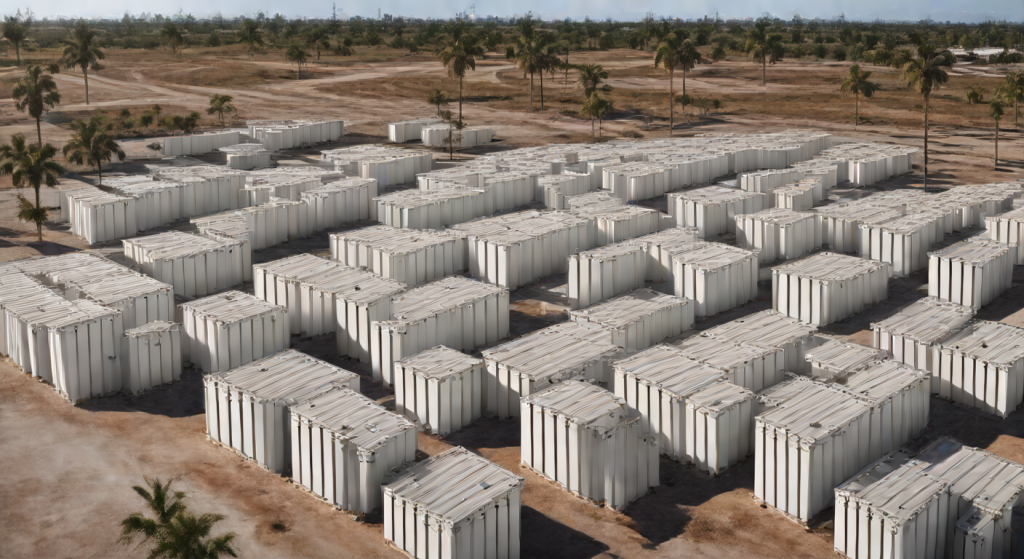
Xos, the Los Angeles commercial-EV manufacturer, on June 2, 2026 launched the Power Hub, a behind-the-meter battery line aimed at data centers and industrial sites that face a three- to seven-year wait for grid interconnection. The series ships in three sizes, 1.2 MWh, 2.5 MWh and 4.0 MWh, each inside a standard intermodal container; the 2.5 MWh unit delivers 1.2 MW of continuous power at 480 volts. Xos says a Power Hub energizes a site in days rather than the years a utility connection now routinely demands. Investors reacted sharply: the company’s shares more than doubled in after-hours trading the day of the announcement.
What’s actually new
The Power Hub is not a fresh battery chemistry. It packages power conversion, plant controls and generator-dispatch logic into one factory-integrated unit: the parts that conventional containerized storage sells as separate DC blocks, power-conversion systems and a microgrid controller. Xos argues that bundling removes the multi-vendor integration work, cutting hundreds of thousands of dollars and compressing the build from quarters to days. The hardware reuses the battery, power-electronics and controls architecture already running across more than 1,400 Xos assets and 250 MWh of deployed storage in North America, so the product repackages fielded technology rather than a prototype.
How it compares
Xos enters a crowded containerized-storage field, but at a smaller unit size. Tesla’s Megapack ships in roughly 5 MWh blocks, and its newer Megablock bundles four Megapacks around one transformer for 20 MWh, both aimed mainly at utility-scale sites. Ford Energy, launched earlier in 2026, targets utilities, data centers and industrial customers with 20-foot containers but will not deliver its first blocks until late 2027. Against those, Xos positions the 1.2-to-4.0 MWh Power Hub as a faster, single-vendor option for sites that need megawatts on site now, with generator-dispatch logic built in for hybrid operation alongside gas or diesel generators.
Critical Perspective
Xos says its 2.5 MWh Power Hub delivers 1.2 MW continuous and can energize a data center in days rather than the three to seven years a grid interconnection now takes, but the company did not disclose pricing for a product it concedes is repackaged battery, power-electronics and controls hardware already fielded across its 1,400 assets, not a new chemistry. The market response was outsized for an integration play: Xos shares more than doubled in after-hours trading on the announcement, even though the firm is a small-cap commercial-EV maker turning to storage because heavy-truck electrification has slowed. Tesla already ships its Megapack in roughly 5 MWh blocks and bundles four into a 20 MWh Megablock around a single transformer, so Xos is entering a crowded field at a smaller unit size against a competitor with far greater manufacturing scale. If the Power Hub’s edge is speed and single-vendor simplicity rather than cost, why has Xos withheld the one number, price per megawatt-hour, that would let a data-center operator judge it against Megapack?
Why It Matters
Interconnection queues have become the binding constraint on US data-center growth, with new large loads waiting years for utility upgrades. Behind-the-meter batteries that carry a site until the grid catches up are drawing entrants from Aligned and Calibrant to Tesla and now Xos. A productized 1.2-to-4.0 MWh unit lowers the entry point for operators that need bridge power without a custom microgrid build, and it gives Xos, a small-cap EV maker, a second market as heavy-truck electrification has slowed. Xos did not disclose Power Hub pricing.
Sources
- Xos press release (GlobeNewswire), June 2, 2026
- Energy-Storage.news, June 5, 2026
- Environment+Energy Leader, June 2026
- Seeking Alpha, June 2, 2026
Related Coverage
| This articleXos Power Hub | Tesla Megapack / Megablock | Ford Energy block | |
|---|---|---|---|
| Unit size | 1.2-4.0 MWh | ~5 MWh (Megablock 20 MWh) | 20-ft container, GWh-scale focus |
| Integration | Single factory-integrated unit (PCS + controls + generator dispatch) | Separate DC blocks + PCS; Megablock bundles 4 + transformer | Integrated 20-ft container (BMS + liquid cooling) |
| Primary target | Data centers & industrial behind-the-meter | Utility-scale + data centers | Utilities, data centers, industrial |
| Availability | Shipping (fielded architecture) | Shipping | First deliveries late 2027 |