State of Data Center Power: 27% of U.S. Facilities Shift
- Analysis Data Centers
Marin Holt
- 0
- 20 minutes read
- Source: DOE Office of Electricity / NASPI technical report, May 28, 2026
- Gas supply (firm): 55,000 MMBtu per day
- Texas 2021: 4.5M+ lost power; ERCOT could import only ~6% of demand from neighbors
- Efficiency payback: 1–3 years (Schneider Electric)
- Project Cost: $2 billion
The data center power landscape is undergoing a fundamental architectural shift: by 2030, 27% of U.S. data centers will run on onsite generation[1]—up from roughly 1% previously—as operators confront grid constraints, AI-driven demand spikes, and interconnection delays that now stretch years rather than months.
Gigawatt-Scale Projects Redefine Infrastructure Planning
Data center power demand has entered the gigawatt era. Box Elder County approved a 9 GW Wonder Valley data center[2] in early May 2026, while Duke Energy added 2.7 GW of new data center contracts in Q1 2026 alone[3]. Individual campuses are scaling rapidly: DC Blox proposed a $2 billion, 78 MW campus[4], and Oracle switched its Project Jupiter New Mexico facility to fuel cells with up to 2.45 GW capacity[5]. These numbers dwarf traditional utility planning cycles. The shift reflects both AI workload intensity and operators’ willingness to bypass grid queues entirely. When TerraVolt signed a firm gas deal for a 200–240 MW behind-the-meter campus in Idaho[6]—securing 55,000 MMBtu per day—it underscored the trend toward self-supplied, dispatchable generation that sidesteps transmission bottlenecks.
Grid Visibility Gaps Emerge as AI Loads Stress Frequency Control
Traditional grid sensors are blind to the high-frequency oscillations AI data centers introduce. A May 28, 2026 DOE Office of Electricity and NASPI technical report[7] warns that today’s phasor measurement units and SCADA systems miss the rapid power swings created by AI inference workloads, which can cycle in milliseconds. This visibility gap compounds operational risk: grid operators lack real-time data on load behavior that can destabilize frequency and voltage. The problem is structural—existing monitoring infrastructure was designed for slower, more predictable industrial and residential loads. As AI campuses proliferate, the mismatch between sensor refresh rates and actual load dynamics threatens both reliability and the ability to coordinate emergency response, a lesson underscored by the 2021 Texas freeze, when ERCOT could import only ~6% of demand from neighbors and 4.5 million lost power[8].
Regulatory and Technical Standards Race to Catch Up
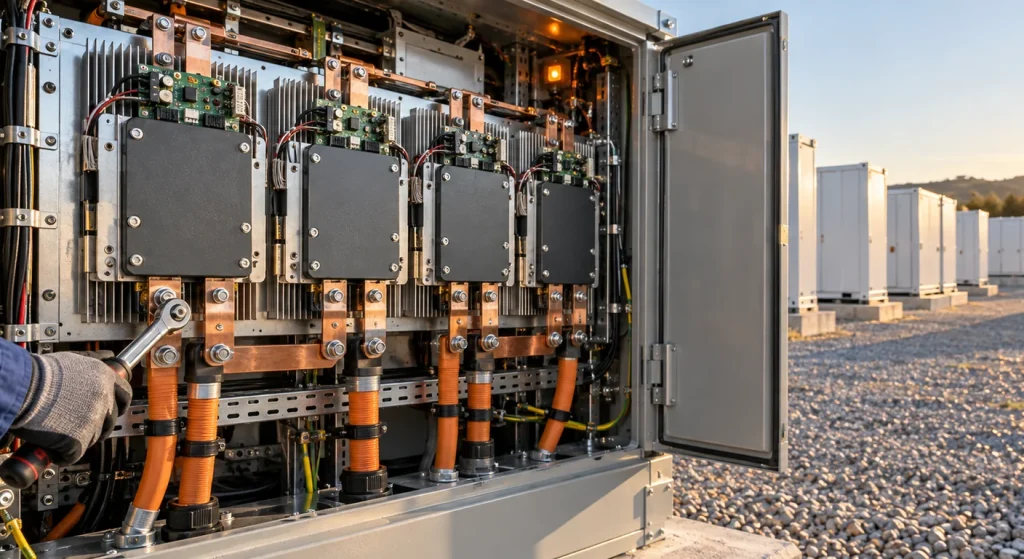
Policy and code frameworks are struggling to keep pace. Oregon ordered data centers to pay 100% of grid upgrade costs[9] in May 2026, shifting infrastructure burden from ratepayers to developers. Hill County, Texas became the first Texas county[10] to impose localized data center siting rules, signaling a wave of county-level governance. On the technical side, NEC Article 706—introduced in 2017 to govern energy storage systems over 50 VAC or 60 VDC—creates a code gap for 800 VDC data center distribution architectures[11] now being deployed with solid-state transformers. Emergency measures are also proliferating: the DOE issued Emergency Order No. 202-26-23 authorizing PJM[12] to take extraordinary steps, reflecting acute capacity pressure in the Mid-Atlantic. These fragmented responses reveal a regulatory system reacting case-by-case rather than anticipating sector-wide transformation.
Energy Efficiency Gains Are Real but Insufficient
Efficiency improvements deliver fast paybacks—Schneider Electric reports 1–3 year returns on energy-efficiency upgrades[13]—yet AI demand growth consistently outpaces savings. Schneider Electric’s Q1 2026 energy management revenue reached $11.4 billion, up 12.8%[14], driven in part by data center optimization projects. Innovations are advancing: Eaton committed approximately S$3 million to the NUS-led Sustainable Tropical Data Centre Testbed, including a 2.5 MW solid-state transformer demonstration[15], and ON.energy tested a medium-voltage AI UPS at the National Lab of the Rockies ARIES platform[16]. These technologies promise step-change improvements in power conversion efficiency and thermal management. Yet the underlying challenge persists: even aggressive efficiency gains cannot offset the exponential rise in compute density and workload intensity that AI training and inference demand.
Hybrid and Renewable Strategies Expand, With Caveats
Operators are diversifying supply. Enbridge broke ground on the $1.2 billion Cowboy Solar project with 1.6 GWh of storage[17], targeting data center offtake. Emerging technologies also attract capital: Star Catcher closed a $65 million Series A to build space-based power beaming for satellites[18], hinting at future extraterrestrial compute infrastructure. Yet renewable integration faces practical limits. Intermittency requires either massive storage or firm backup—hence the persistence of gas and fuel-cell solutions. The Idaho TerraVolt project’s firm gas contract and Oracle’s gigawatt-scale fuel cell pivot illustrate that, for now, dispatchable fossil and hydrogen-ready generation remain essential for 24/7 uptime guarantees that AI workloads demand.
What to Watch
Sensor and telemetry upgrades: Whether DOE, FERC, or ISOs mandate high-frequency monitoring to capture AI load dynamics—and who pays for the retrofit.
State and county siting battles: As Oregon and Hill County set precedents, expect more jurisdictions to impose cost-sharing, environmental reviews, or outright moratoria on hyperscale projects.
800 VDC and solid-state transformer adoption: Progress on NEC code revisions and real-world deployments beyond testbeds will signal whether DC distribution can scale economically.
Onsite generation economics: Whether the 27% forecast accelerates if interconnection queues lengthen further, and how utilities respond with tariff reforms or fast-track programs for self-supplied campuses.
Why It Matters
Pillar pages are how operators, planners, and procurement leads orient themselves in a fast-moving subsector. The value is not the aggregate numbers — those drift weekly — but the ability to follow named projects, vendors, and policy actions as they progress through stages. Use this index as a launch point into the stage-tagged underlying articles, where the actual decision-grade detail lives. For utility planners, this is most useful as a quarterly scan; for procurement leads tracking a specific vendor or technology, the named-entity articles linked from here are the higher-resolution view.
Critical Perspective
This pillar aggregates MGRID’s recent coverage of the category. Readers should treat the aggregate numbers cited above as a snapshot of a fast-moving sector, not a final scoreboard. Three caveats: (1) project counts and capacity figures conflate announced, funded, under-construction, and operational tiers, so individual articles should be consulted for stage-specific status; (2) the corpus reflects what MGRID has covered, not the full universe of activity globally; (3) MW and dollar totals are nominal at time of publication and do not adjust for cancelled or restructured projects. Use the pillar to navigate, but ground decisions in the underlying named-entity articles.
Sources
- POWER Magazine: 27% of US Data Centers to Run on Onsite Generation [1]
- Box Elder County Approves 9 GW Wonder Valley Data Center [2]
- Duke Energy Adds 2.7 GW of Q1 Data Center Contracts [3]
- DC Blox Proposes $2 Billion 78 MW Data Center Campus [4]
- Oracle Switches Project Jupiter New Mexico Data Center [5]
- TerraVolt Signs Firm Gas Deal for 200-240 MW Behind-the-Meter Data Center Campus in Idaho [6]
- DOE: Today’s Grid Sensors Miss the High-Frequency Oscillations AI Data Centers Create [7]
- Why Neighboring Power Grids Can’t Just Send Electricity Where It’s Needed — and the 2021 Texas Lesson [8]
- Oregon Orders Data Centers to Pay 100% [9]
- Hill County Texas Becomes First Texas County [10]
- NEC Article 706 and the 800 VDC Data Center Distribution Code Gap That Solid-State Transformer Deployments Must Bridge [11]
- DOE Issues Emergency Order Authorizing PJM [12]
- Schneider: Energy-Efficiency Upgrades Pay Back in 1–3 Years — Yet AI Demand Keeps Outrunning Them [13]
- Schneider Electric Energy Management Revenue Up 12.8% [14]
- Eaton Commits S$3 Million for NUS-Led Sustainable Tropical Data Centre Testbed With 2.5 MW Solid-State Transformer Demonstration [15]
- ON.energy Tests Medium-Voltage AI UPS [16]
- Enbridge Breaks Ground on $1.2 Billion Cowboy Solar and 1.6 GWh [17]
- Star Catcher Closes $65M Series A to Build Space-Based Power Beaming for Satellites [18]
References
- [1] POWER Magazine: 27% of US Data Centers to Run on Onsite Generation
- [2] Box Elder County Approves 9 GW Wonder Valley Data Center
- [3] Duke Energy Adds 2.7 GW of Q1 Data Center Contracts
- [4] DC Blox Proposes $2 Billion 78 MW Data Center Campus
- [5] Oracle Switches Project Jupiter New Mexico Data Center
- [6] TerraVolt Signs Firm Gas Deal for 200-240 MW Behind-the-Meter Data Center Campus in Idaho
- [7] DOE: Today’s Grid Sensors Miss the High-Frequency Oscillations AI Data Centers Create
- [8] Why Neighboring Power Grids Can’t Just Send Electricity Where It’s Needed — and the 2021 Texas Lesson
- [9] Oregon Orders Data Centers to Pay 100%
- [10] Hill County Texas Becomes First Texas County
- [11] NEC Article 706 and the 800 VDC Data Center Distribution Code Gap That Solid-State Transformer Deployments Must Bridge
- [12] DOE Issues Emergency Order Authorizing PJM
- [13] Schneider: Energy-Efficiency Upgrades Pay Back in 1–3 Years — Yet AI Demand Keeps Outrunning Them
- [14] Schneider Electric Energy Management Revenue Up 12.8%
- [15] Eaton Commits S$3 Million for NUS-Led Sustainable Tropical Data Centre Testbed With 2.5 MW Solid-State Transformer Demonstration
- [16] ON.energy Tests Medium-Voltage AI UPS
- [17] Enbridge Breaks Ground on $1.2 Billion Cowboy Solar and 1.6 GWh
- [18] Star Catcher Closes $65M Series A to Build Space-Based Power Beaming for Satellites
Related Coverage
Update: Late June 2026
Late June turned the data-center power story from a demand-forecast debate into a procurement scramble. The marquee move was Chevron and Microsoft signing a 20-year deal for a 2.67 GW off-grid gas plant, a scale of behind-the-fence generation that effectively concedes the public grid cannot connect hyperscale load fast enough. Cummins agreed to supply 2 GW of on-site power to Circe Energy’s West Texas AI campuses, and Crusoe tapped Bergen Engines for another 750 MW of gas, while nuclear crept in via Valar Atomics bringing its Ward 250 reactor critical in Utah. The common thread is gas and, increasingly, atoms — not the renewables-plus-storage narrative the sector prefers to tell.
The regulatory backlash arrived in the same window. FERC ordered all six grid operators to rework how they study and charge large loads, Michigan senate bills would force 20 MW-plus data centers into 20-year commitments, and ERCOT disclosed that four data-center and crypto groups failed a voltage ride-through test, a concrete data point behind the abstract worry that these loads destabilize the grid they plug into. Set against Verse’s $54 million Series B and continued VPP experiments like Google’s 100 MW PJM virtual power plant with Voltus, the picture is a sector racing to secure firm megawatts while regulators race to make it pay for the strain. The 27% figure this pillar opened with now looks conservative.