DOE: Today’s Grid Sensors Miss the High-Frequency Oscillations AI
- Analysis Data Centers
Marin Holt
- 0
- 6 minutes read
- Source: DOE Office of Electricity / NASPI technical report, May 28, 2026
- Core finding: Phasor measurement units (PMUs) miss or misrepresent high-frequency oscillations from AI workloads
- Cause: Thousands of synchronized AI chips create repetitive load fluctuations spanning a wide frequency range
- Recommended fix: Hybrid PMU + point-on-wave (POW) monitoring
- Funders: DOE Office of Electricity, Pacific Northwest National Laboratory, EPRI
The U.S. Department of Energy’s Office of Electricity warned on May 28, 2026 that the phasor measurement units (PMUs) utilities rely on to watch grid stability systematically miss the high-frequency oscillations large AI data centers inject into the power system. A technical report from NASPI (Novel Applications for Synchronized Power Instrumentation), authored by program manager Sandra Jenkins, concludes that PMU filtering causes the devices to “miss or misrepresent high-frequency oscillations” from AI workloads even when their reporting rate is increased.
Why AI Loads Oscillate
A modern AI training cluster runs thousands of accelerator chips in lock-step. When those chips ramp synchronously between compute phases, they create repetitive electrical load fluctuations. Per the DOE report, those fluctuations “can span a wide range of frequencies, some of which may adversely interfere with equipment at nearby power plants.” This is a different problem from the steady 24/7 demand that data centers are usually discussed in terms of: it is a dynamic, oscillatory signature that conventional load models do not capture and that sits in a frequency band the grid was not built to observe.
The Monitoring Gap
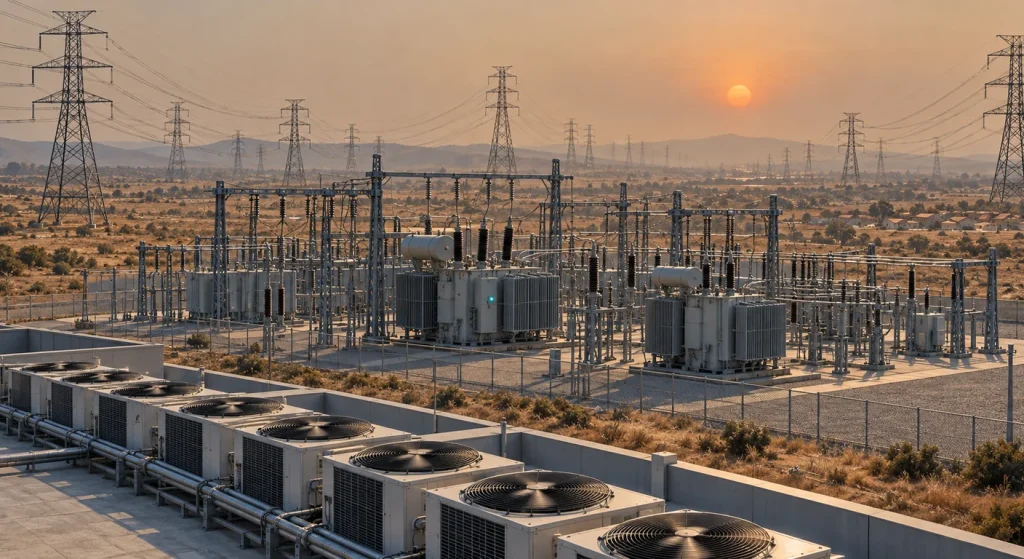
Phasor measurement units excel at detecting low-frequency oscillations and are the backbone of wide-area grid monitoring. But their internal filtering, the DOE report finds, blinds them to the high-frequency content AI loads produce. Point-on-wave (POW) measurements capture the full frequency range and resolve the high-frequency dynamics PMUs lose, but they generate far larger data volumes, creating what the report calls “communication and storage challenges.” Neither instrument alone gives utilities a complete picture of what an AI campus is doing to the local grid.
The Recommended Fix
The DOE/NASPI report concludes that a hybrid approach, combining PMU and POW measurements, “offers the most reliable pathway for assessing oscillations from large loads and supporting utility compliance.” The work was funded by the DOE Office of Electricity, Pacific Northwest National Laboratory, and the Electric Power Research Institute. For utilities now interconnecting gigawatt-scale AI campuses, the finding reframes the monitoring question: assessing an AI load’s grid impact requires instrumentation most substations do not currently deploy.
Why It Matters
As AI data center interconnections accelerate, the gap between what the grid does and what utilities can measure becomes a reliability risk. If a campus is exciting an oscillation mode that interferes with a nearby generator and the local PMUs cannot see it, the first sign of trouble may be equipment damage rather than a monitoring alert. The DOE guidance gives utilities and large-load customers a concrete pre-interconnection requirement: pair PMU coverage with point-on-wave measurement at the points where AI campuses connect, before the load energizes, not after.
Related Coverage
Critical Perspective
Coverage that summarizes a single report or research finding should be read alongside the methodology section of the source. Two structural caveats: (1) sample size, geographic scope, and time window of the original research determine how generalizable the finding is, so a US-only utility survey does not map directly onto European or Asian grid conditions; (2) the framing decisions of the report’s authors (what they chose to measure, what they chose to omit) shape the conclusion as much as the data does. MGRID’s role is to surface the finding and the framing tradeoffs, not to endorse the conclusion.