Grid United’s $4 Billion Wyoming Intertie Wins $2.8 Billion Conditional Federal Loan
- FERC & Federal News Policy & Markets
Marin Holt
- 0
- 7 minutes read
- Project cost: $4 billion
- Conditional federal loan: $2.8 billion
- Bidirectional transfer capacity: 1,800 MW
- DOE estimated ratepayer savings over 30 years: $39 billion
- Route on state and federal land: 90%
The U.S. Department of Energy is backing Houston-based Grid United’s $4 billion Wyoming Intertie with a $2.8 billion conditional loan from the federal Energy Dominance Financing program. DOE announced the support the week before Renewable Energy World reported it. The proposed 106-mile line will run high-voltage wires from the Laramie River Station outside Wheatland west to the Aeolus substation near Medicine Bow. It will add 1,800 MW of bidirectional transfer capacity between the eastern and western grids. Construction could begin around 2030, with completion targeted for about 2033.
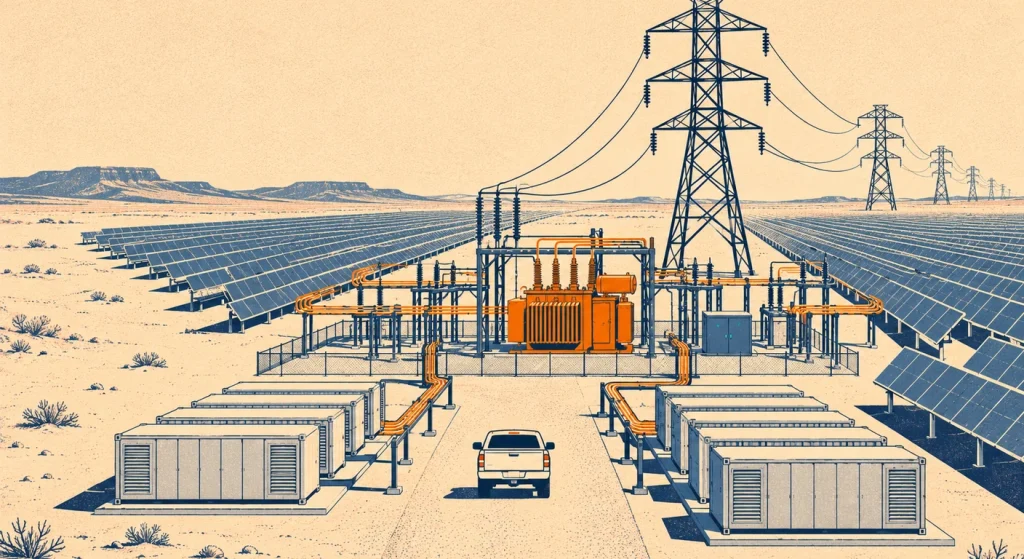
DOE said the intertie will double the flow of electricity between the eastern and western grids. The two systems are not synchronized, so they cannot trade power through a conventional alternating-current connection. Grid United first conceived the Wyoming Intertie in 2022, and the plan went through different iterations. The project will use high-voltage direct-current conversion facilities to link the asynchronous networks. Operators will then move electricity between regions during high demand, generation outages and extreme weather.
Terminal Siting and Land
Laramie River Station anchors the eastern end of the line. The coal-fired plant is one of the few power plants with access to both grids. John Jenks, director of energy market development at the Wyoming Energy Authority, told WyoFile that this access likely makes the plant an ideal place to strengthen the link between the two systems.
The route runs from Platte County to Carbon County. Beard of Grid United said about 90% of it crosses state and federally owned land, and the project is in line for possible fast-track permitting. Beard told Engineering News-Record that the company has secured options covering approximately 97% of the route. He said the line is unlikely to face significant property condemnation disputes.
Conversion Costs and Federal Financing
Conversion equipment drives the budget. Beard said more than half of the project cost goes to the conversion technology. The direct-current converter stations are what let the two non-synchronized grids exchange power.
Beard said the financing works much like a direct federal loan from the borrower’s side. Technically, it is structured as a loan guarantee involving the Federal Financing Bank.
Grid United’s Second Interregional Line
Grid United is also developing the North Plains Connector. That proposed 420-mile, 3,000-MW transmission project would link Montana and North Dakota. It would connect the western grid with the Southwest Power Pool and Midcontinent Independent System Operator regions.
Why It Matters
The Wyoming Intertie targets the physical seam between the two largest U.S. power grids. Doubling the power that moves across that seam gives operators more room to share supply when one region runs short.
DOE estimates the line will save ratepayers in Wyoming and 17 other states a combined $39 billion in avoided costs over the next 30 years. The 1,800 MW link would be available in both directions during outages, extreme weather and peak demand.
Critical Perspective
The U.S. Department of Energy offered a $2.8 billion conditional loan, but this federal financing commitment is not yet finalized. Grid United designed the line to add 1,800 MW of bidirectional transfer capacity across the seam, yet Beard acknowledged that more than half of the $4 billion budget goes directly to conversion technology. DOE estimates the intertie will save ratepayers a combined $39 billion in avoided costs, yet those projected benefits depend on complex direct-current converter stations that have not broken ground. Can Grid United keep conversion equipment costs under control when specialized converter hardware dominates the project budget?