Gas Power Proposed for US Data Centers Doubled to 189 GW in Six Months, and Texas Holds 77 GW of It
- Analysis Data Centers Grid Capacity
Marin Holt
- 0
- 11 minutes read
- Gas proposed at US data centers: 189 GW
- Six months earlier: 97 GW
- Texas share: 77 GW
- Total US gas in development: 378 GW
- Engine-based capacity: 45 GW
Gas-fired capacity proposed to sit directly next to US data centers reached 189 GW by mid-2026. The count was 97 GW at the start of the year. Global Energy Monitor published the figures on August 25, 2026, in its Global Oil and Gas Plant Tracker. Texas carries 77 GW of that total, close to two-thirds of the 122 GW the state now has in development.
The Data
Total US gas capacity in development rose 50 percent to 378 GW. That is 127 GW above the January 2026 figure of 252 GW. Texas grew 51 percent, or 41.4 GW, from the 80.6 GW that Global Energy Monitor reported in January. The tracker counts announced, pre-construction and construction phases together.
The technology mix is the part that grid engineers should read twice. Simple-cycle turbines and reciprocating engines account for nearly half of the data center proposals. Engines alone reached 45 GW in development, close to a quarter of the data center total, after more than tripling in six months. Developers reach for engines because combined-cycle turbine order books are full.
Permit filings compiled by Inside Climate News put numbers on the largest Texas sites. GW Ranch Energy Center in Pecos County holds the largest air permit issued in the country this year. The filing expects 33 million tons of greenhouse gas per year. Amazon acquired that project in August. Project Matador in the Panhandle, developed by Fermi America, lists 90 combined-cycle turbines, 16 cooling towers and six emergency engines against 24 million tons per year.
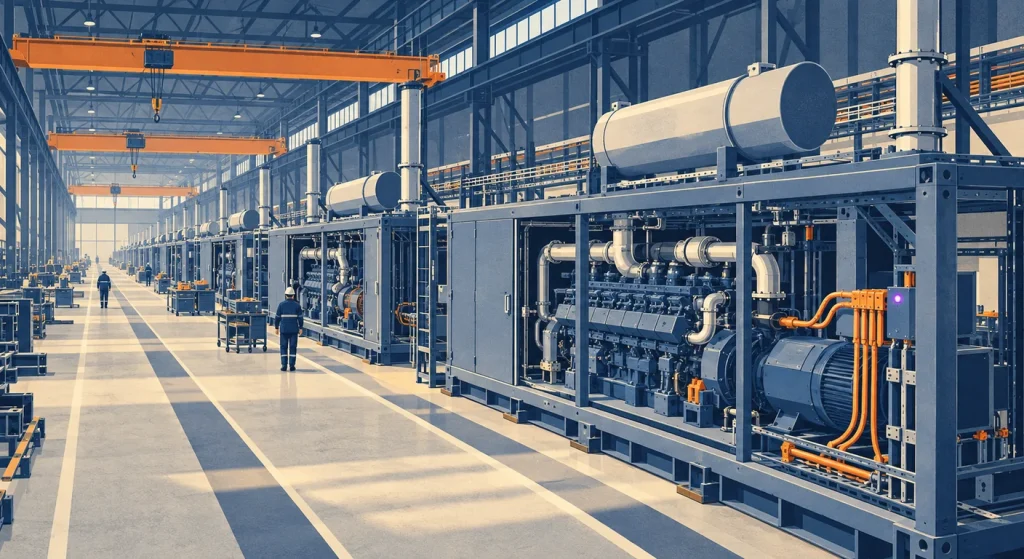
Further down the list the machine count tells the story. Westline 2335 proposes 240 gas generators in 20 engine halls. Roman Energy Center proposes 640 gas generators plus 25 diesel backup engines. A site south of Dallas filed for 891 Caterpillar 3516E generators.
Why It Matters
A campus built from hundreds of reciprocating engines is a different electrical machine than a two-unit combined-cycle plant. Each engine is a small synchronous generator with its own controls and its own protection settings. Fault current, harmonic contribution and voltage regulation all change when 640 units replace two large sets. Interconnection studies written for large rotating plant do not transfer cleanly.
The shift also moves the schedule. Engines arrive on trucks and start in months, while a combined-cycle unit waits years for a turbine slot. That speed is exactly why the engine number tripled. It also means capacity lands ahead of the transmission studies that normally pace new generation.
The Gap
The tracker counts proposals, not steel. It does not say which projects clear air permits, secure gas supply or reach financial close. Jenny Martos, who runs the tracker for Global Energy Monitor, put the problem plainly. “This frenzy of gas proposals is running headlong into the hurdles of an already tight gas market,” she said.
Two questions stay open. The report does not separate capacity that will island behind the meter from capacity that will also serve the grid. That distinction decides whether these projects relieve ERCOT or simply hide load from it. The report also gives no attrition rate. A reader cannot tell how much of the 189 GW is a real pipeline and how much is a land position.
Critical Perspective
A doubling in six months measures announcement behavior at least as much as it measures construction. The same tracker showed 97 GW in January and 189 GW in June, which tells you the number moves faster than concrete does. Nothing in the count distinguishes a signed turbine order from a land option and a press release.
The emissions figures deserve the same caution. An air permit is sized for maximum permitted operation, not expected operation, so GW Ranch’s 33 million tons per year is a ceiling. A behind-the-meter plant that follows a data center load runs at a capacity factor nobody has published.
The engineering question stays unanswered. No public study covers what 640 reciprocating engines at one site do to local fault duty, harmonic distortion and voltage regulation, or how ERCOT should model them. The permit filings count machines and tons. They say nothing about power quality at the point of common coupling, and that is the number a neighboring industrial customer will feel first.
Sources
- Global Energy Monitor, “U.S. gas power proposals tied to data centers nearly double in six months,” August 2026
- Inside Climate News, “Data Center Developers in Texas Plan Massive New Gas Power Projects,” August 25, 2026
- RTO Insider, “U.S. Data Center Gas Power Proposals Double in 6 Months,” August 25, 2026
- Global Energy Monitor, “Betting big on data centers, U.S. now leads world for new gas power development,” January 2026 baseline figures