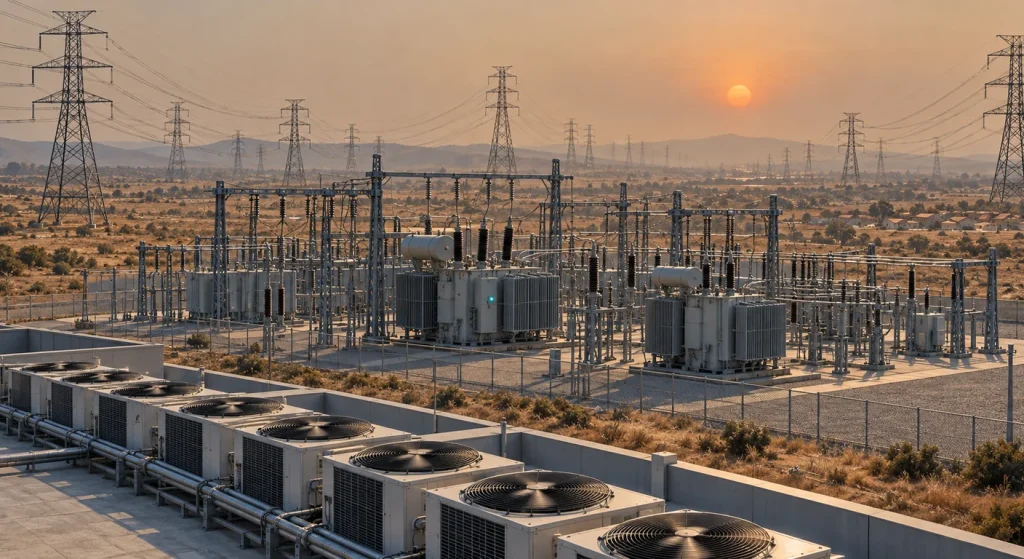
Oregon Orders Data Centers to Pay 100%

- Order Date: 2026-05-08
- Cost Allocation: 100% of distribution expansion borne by large user
- Minimum Load Threshold: 20 MW
- Very-Large-Load Surcharge: 1 cent/kWh on customers above 100 MW
- Effective Date: June 10, 2026
Starting June 10, 2026, large energy users in Oregon that draw 20 MW or more will pay the full cost of distribution system expansion. They must also use at least 90% of their contracted capacity. The Oregon Public Utility Commission (OPUC) made this ruling to implement House Bill 3546, the POWER Act.
Changes
Under the OPUC order, any facility drawing 20 MW or more must now bear the full cost of the distribution infrastructure expansion it triggers — not the 100 percent figure applied to all ratepayers under the old cost-socialization model. The 90 percent contracted-capacity usage floor means operators cannot reserve grid headroom speculatively and leave it idle; sustained underuse exposes them to renegotiation or penalty. Facilities above 100 MW carry an extra 1 cent per kilowatt-hour surcharge, the proceeds of which fund low-income energy-burden relief programs rather than utility earnings. PGE, PacifiCorp, and Idaho Power must file conforming tariffs; rate changes land June 10, 2026, while most operational changes are immediate. A queue system gates new large-load interconnections on available zero-emission generation capacity.
No Changes
The order does not change interconnection processes for smaller energy users or those using less than 20 MW. Utilities still maintain and upgrade their distribution infrastructure. However, the cost recovery mechanism for expansions driven by large new loads has changed.
Enforcement
Compliance rests on utility reporting: PGE, PacifiCorp, and Idaho Power track contracted-capacity utilization and flag customers that fall below the 90 percent threshold. The OPUC holds enforcement authority under the POWER Act, and the practical consequence of persistent underuse is contract renegotiation or financial penalty — not merely a warning. The 1 cent per kilowatt-hour surcharge on loads above 100 MW flows through utility billing and is remitted to the state for distribution to low-income customers; utilities act as collection agents, not beneficiaries.
Impact
Large energy-using facilities, especially data centers, must assess their energy consumption and operational patterns against the new requirements. They must renegotiate contracts with utilities to reflect the new cost allocation and usage commitments. Utilities must revise tariffs and operational planning to account for the queue system and surcharge collection.
Perspective
The effectiveness of the 90% contracted capacity usage requirement depends on accurate metering and reporting. The queue system’s success hinges on the OPUC’s ability to forecast zero-emission generation availability and manage the queue transparently. The order addresses concerns about residential customer subsidies for hyperscale loads. However, its long-term impact on Oregon’s competitiveness for large energy users and the effectiveness of the surcharge in providing relief to low-income customers requires monitoring.
Sources
Why It Matters
Hyperscale siting decisions in 2026 and 2027 will weight Oregon against Washington, Idaho, and Nevada more heavily than before; data center developers should request scenario analysis comparing Oregon POWER Act costs against neighboring-state alternatives before committing to Oregon land. Oregon utilities should plan for the possibility that load growth slows below their IRP projections, which affects every transmission and generation investment thesis in the integrated planning cycle.
Critical Perspective
The Oregon POWER Act represents the most aggressive state-level cost-allocation shift to large energy users in the country, but the practical effect depends on enforcement details the OPUC has not yet fully specified. Loads that fall just below the 20 MW threshold (large warehouses, mid-sized industrial users, small data centers) face no new costs, creating an incentive to design facilities to 19 MW peak rather than 20+ MW, which would dilute the policy’s revenue projection. The 90 percent contracted-capacity utilization requirement assumes a stable load profile that AI training workloads (variable, burst-y, project-dependent) cannot easily guarantee; non-compliance penalties or contract restructurings will likely follow within the first 18 months. Distribution utilities serving large Oregon loads (PGE, PacifiCorp) will need to revise their integrated resource plans to reflect the new revenue stream, but those plans assume data center load growth continues; if the cost allocation deters new siting, the projected revenue underwriting transmission upgrades may not materialize. The energy-burden relief surcharge funded by the 1-cent-per-kWh surcharge on 100+ MW loads is a small fraction of total Oregon LIHEAP need, so framing the POWER Act as low-income relief overstates the policy’s redistributive effect.