Solar-Battery Pilot Runs 720 kW of DC Fast Charging in Iceland
- EVs Infrastructure & Grid Connection News Solar + Storage Integration
Marin Holt
- 1
- 7 minutes read
- ON Power (Reykjavik Energy subsidiary) commissioned solar-plus-storage EV charging hub at headquarters in November 2025 with 100+ kW PV, 450 kWh battery, and three 240 kW DC fast chargers
- System delivers up to 720 kW combined peak charging capacity; battery buffer allows chargers to exceed the solar generation rate and smooth grid demand from simultaneous charging
- Installation serves as a live research platform to test solar integration, storage dispatch, and DC fast charger harmonics management under Iceland grid conditions
- Iceland grid is 100% renewable (geothermal and hydro); project tests how solar-battery hybridization reduces grid draw peaks at high-power EV charging sites
- Three 240 kW DC fast chargers form the charging side; a 450 kWh battery system provides buffer storage between solar generation and vehicle charging events
ON Power, a subsidiary of Reykjavik Energy, commissioned a solar-plus-battery-plus-DC-fast-charging installation at its Reykjavik headquarters in November 2025. The system pairs more than 100 kW of photovoltaic panels with a 450 kWh lithium-ion battery and three 240 kW DC fast chargers, delivering 720 kW of combined peak charging capacity. ON Power uses the installation as a pilot to test control strategies before deploying similar configurations at EV charging hubs across Iceland.
System Configuration
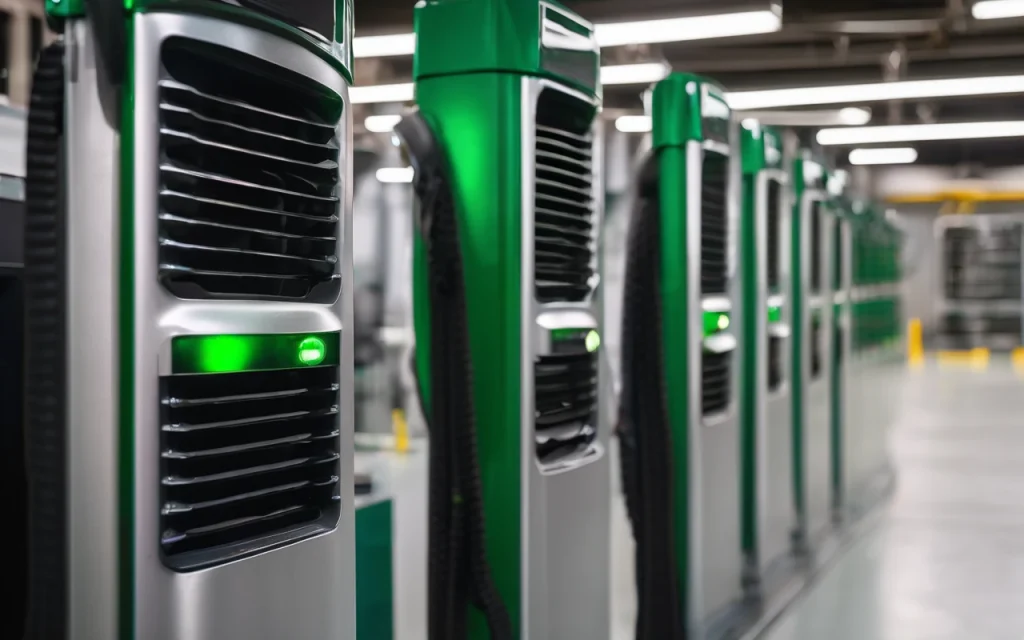
The installation, named Peaker Plant, uses 230 bifacial glass-glass modules from Jolywood rated at 445 W each, mounted on both the rooftop and building facade. The battery, supplied by Elecnova, holds 450 kWh. Three Autel DC fast chargers, each rated at 240 kW, serve the site.
The control system operates in three modes: PV self-consumption maximization, load smoothing during rapid charging sessions, and grid services. ON Power reports better-than-expected alignment between on-site solar generation and charging demand during winter conditions, a finding that matters in Iceland’s high-latitude environment where winter sun angles are low.
Why DC-Coupled Systems Suit Fast-Charging Facilities
DC fast-charging hubs create a specific grid problem: large, unpredictable power bursts. A single 240 kW charger serving a heavy truck draws more power than most small commercial buildings. Three running simultaneously create a demand spike that strains distribution transformers and triggers utility demand charge thresholds.
Battery storage flattens the demand curve. The battery absorbs solar generation during off-peak periods and discharges during charging sessions, reducing the peak grid draw. DC coupling, where the battery and solar share the same DC bus before conversion to AC, avoids the efficiency losses of converting solar to AC and back to DC for storage, typically recovering 2 to 5 percentage points of round-trip efficiency over AC-coupled designs. For facilities running DC fast chargers, DC coupling also simplifies the power path between battery and charger.
The same logic drives U.S. fleet depot projects. NFI Industries in Ontario, California, received a $27 million state grant for a 1 MW solar and 7 MWh battery system supporting 50 electric trucks. WattEV in Bakersfield combined 5 MW solar with 3 MWh of storage at its charging facility, which now delivers over 11 MW of total charging capacity. The Iceland installation is smaller, but it demonstrates the control architecture performs at solar irradiance levels below what most U.S. operators plan around.
Implementation Details
ON Power began planning in late 2024 and completed construction in November 2025. No total project cost figures were disclosed. The utility plans to replicate the configuration at multiple primary EV charging hubs throughout Iceland.
The pilot’s grid-services mode positions ON Power to participate in frequency regulation or demand response markets if Iceland’s grid operator opens capacity for distributed assets. U.S. charging depot operators are pursuing similar arrangements, using battery systems to provide ancillary services during off-peak charging hours. Grid services revenue can materially improve project economics for large-battery installations that would otherwise sit idle during low-demand periods.
Source: PV Magazine, March 17, 2026
Critical Analysis
Three 240 kW DC fast chargers with active rectifiers inject harmonics at the point of common coupling; on-site battery buffer absorbs charging transients and flattens. Battery buffering at 720 kW reduces grid-facing peak demand from charging, though solar export periods may challenge local hosting capacity limits.
5-Year Projection
By 2031, operational data from facilities like this will become the standard requirement for securing interconnection agreements, as ISOs prioritize proven Solar PV profiles.
Critical Perspective
The reported 720 kW peak charging capacity for this Icelandic pilot is a modest figure, dwarfed by the 11 MW total charging capacity at WattEV’s Bakersfield facility. While ON Power claims better-than-expected solar alignment, the 450 kWh battery capacity is a fraction of the 7 MWh deployed by NFI Industries for their fleet depot. The promise of improved efficiency through DC coupling mirrors the rationale behind numerous U.S. fleet charging projects, yet the actual grid impact of this small-scale Icelandic operation remains unproven. Given the significant capital investment required for such systems, what is the projected lifespan of this pilot before it becomes economically unviable?