Green Hydrogen Electrolyzer Interconnect Is the Largest Underdeveloped Solid-State Transformer Market Opportunity

- Electrolyzer stack voltages: 200-1500 VDC depending on cell technology and stack configuration
- Hydrogen Council projects 10-25 Mt/yr green hydrogen by 2030 u2192 100-250 GW electrolyzer installed capacity
- Conventional supply: step-down + thyristor rectifier (60-year architecture) + auxiliary harmonic/PFC/regulation
- SST architecture: single conversion stage with intrinsic harmonic + PFC + voltage regulation
- Plausible $1B-$3B annual SST revenue opportunity at electrolyzer interconnect by 2030
The green-hydrogen-electrolyzer industry is the single largest underdeveloped commercial opportunity for solid-state transformer (SST) adoption. The production of green hydrogen — hydrogen produced via electrolysis using electricity from renewable sources — requires multi-megawatt to tens-of-megawatt DC power supply equipment at the electrolyzer cell stack. The fundamental compatibility between electrolyzer DC demand, intermittent renewable AC supply, and the SST’s AC-to-DC conversion with active power-quality control makes this market segment a near-perfect product-market fit for SST technology.
The technical requirements an SST must meet to feed an electrolyzer stack are demanding but well-defined. The electrolyzer operates at a stack voltage typically between 200 volts DC and 1,500 volts DC depending on cell technology and stack configuration. The current draw is high — several thousand amperes per stack at production scale. The voltage must be tightly regulated to keep the electrolyzer cells within their optimal electrochemical operating window. And the AC-side connection to the renewable source must handle the variability of solar and wind output without disrupting the steady DC delivery to the electrolyzer.
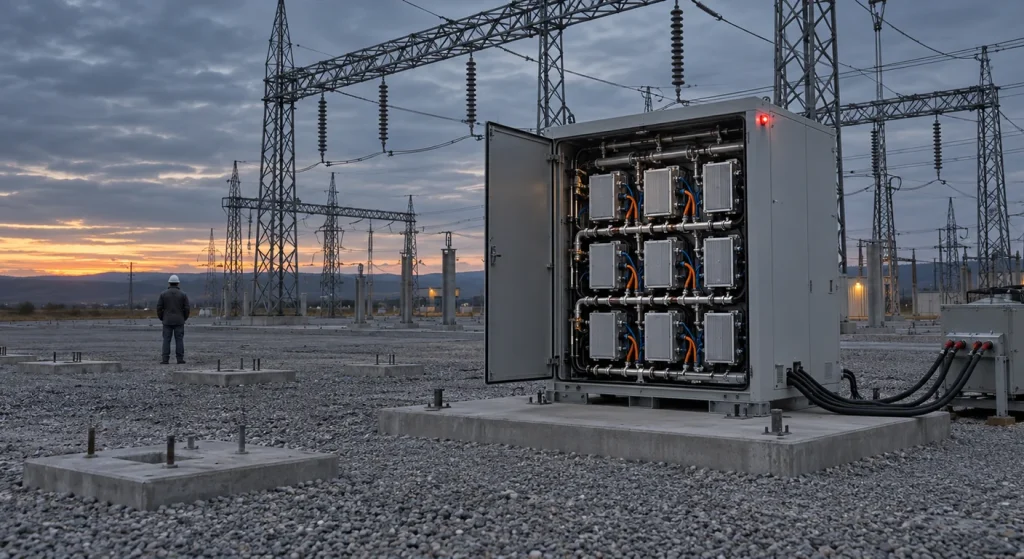
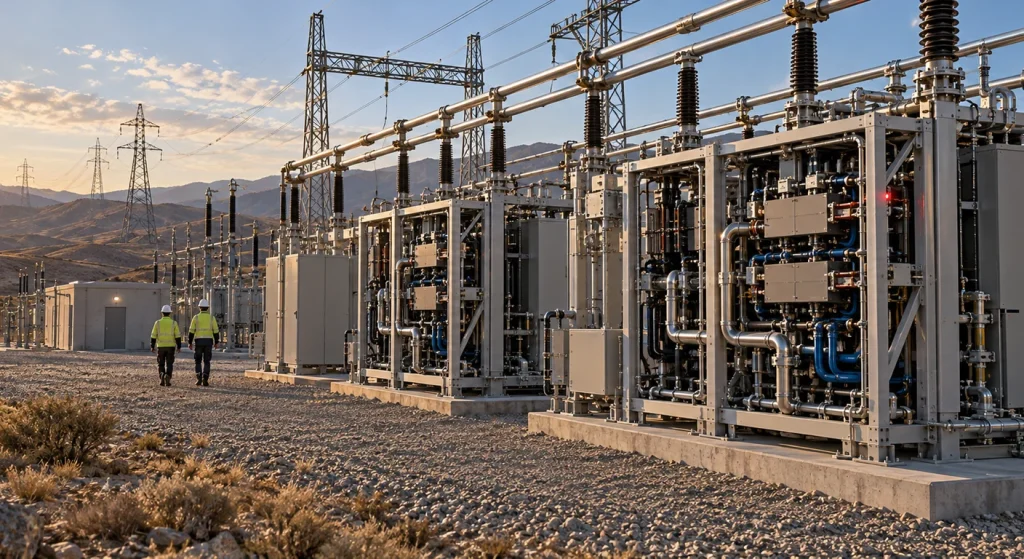
The conventional supply-chain solution today is a step-down transformer plus a thyristor rectifier — the same architecture used in chlor-alkali electrolysis for sixty years. The architecture works but does not natively handle renewable variability and requires substantial auxiliary equipment (harmonic filters, power-factor correction, voltage regulation) to deliver the required quality of DC output. An integrated SST architecture replaces the conventional step-down-plus-rectifier with a single conversion stage that intrinsically provides the harmonic suppression, power-factor correction, and voltage regulation.
The market sizing depends on green-hydrogen production growth, which is itself uncertain. The Hydrogen Council projects global green hydrogen production at 10 to 25 million tonnes per year by 2030. At electrolyzer efficiencies of 60 to 70 percent and stack voltages of 200 to 1500 VDC, the installed electrolyzer capacity to support that production runs 100 to 250 gigawatts. The SST opportunity at the interconnect interface — typically 1 to 5 SSTs per electrolyzer plant at the multi-megawatt scale — could plausibly reach $1 billion to $3 billion in annual revenue by 2030 if SST adoption is widespread.
The strategic question is which SST manufacturer will own the green-hydrogen interconnect application. Eaton-Resilient, ABB, Hitachi Energy, and Siemens Energy each have credible positions to enter the segment. None has publicly committed to a dedicated electrolyzer-interconnect product line. The first major commercial reference will be informative. Whether the SST industry treats green-hydrogen interconnect as a strategic priority or as an opportunistic adjacent market will determine how rapidly the segment matures through 2028 and beyond.
Why It Matters
For the hydrogen sector, multi-megawatt electrolyzer stacks need large, controllable DC supplies fed from intermittent renewable AC, which is close to a native match for the SST’s AC-to-DC conversion with active power-quality control. If green-hydrogen buildout accelerates, it becomes a second large SST demand pool alongside data centers, and it is the one the market has priced in least, making it the segment most likely to surprise on volume.
Critical Perspective
Editorial correction: This post is part of MGRID’s Solid-State Transformer industry coverage. As of May 2026, that body of work systematically framed manufacturer announcements, funding rounds, and laboratory demonstrations as commercial deployments. The reality is that field-deployed commercial-class SST in revenue service globally is measured in single digits, and almost every product cited in this series is at “announced” or “funded” stage, not “operational.” Readers should treat the specific claims in this post against the standards documented in our SST Industry Reality Check (the per-claim audit table maps marketing language to verifiable deployment status). The corrective article is the canonical reference for SST industry reality; this post remains published with its original framing so the editorial drift is traceable.
Related Coverage
Plausible $1B-$3B annual SST revenue opportunity at electrolyzer interconnect by 2030