Exelon Sees Up to $8 Billion in Utility Storage as Its New Jersey Project Faces a Dismissal Bid
- Energy Storage News State & Local Regulation Utility-Scale BESS
Marin Holt
- 0
- 8 minutes read
- Potential storage spending: $8 billion
- New Jersey proposal: 500-MW
- Projected customer net benefits: $700 million
- Transmission plan through 2029: $16.3 billion
- High-probability large load: 11 GW
Exelon utilities could spend as much as $8 billion on regulated energy storage, Utility Dive reported after the company’s earnings call. Officials put the range at $3 billion to $7 billion for 1.5 GW to 3.5 GW of storage, on top of a separate $1 billion, 500-MW proposal in New Jersey.
The additional spending represents potential projects. Atlantic City Electric’s New Jersey proposal, developed with Invenergy, awaits a decision from the New Jersey Board of Public Utilities.
Exelon expects that decision late in the first quarter next year, CFO Robert Kleczynski said, according to Utility Dive. The regulatory decision is the next milestone for the proposed New Jersey installation.
That decision is contested. New Jersey’s Division of Rate Counsel has asked the board to dismiss the petition, arguing that the state’s 1999 restructuring law forbids rate-regulated utility ownership of generation, The Duck Curve reported. PJM’s independent market monitor has backed the motion. Atlantic City Electric filed its opposition on Oct. 30, the day of the earnings call.
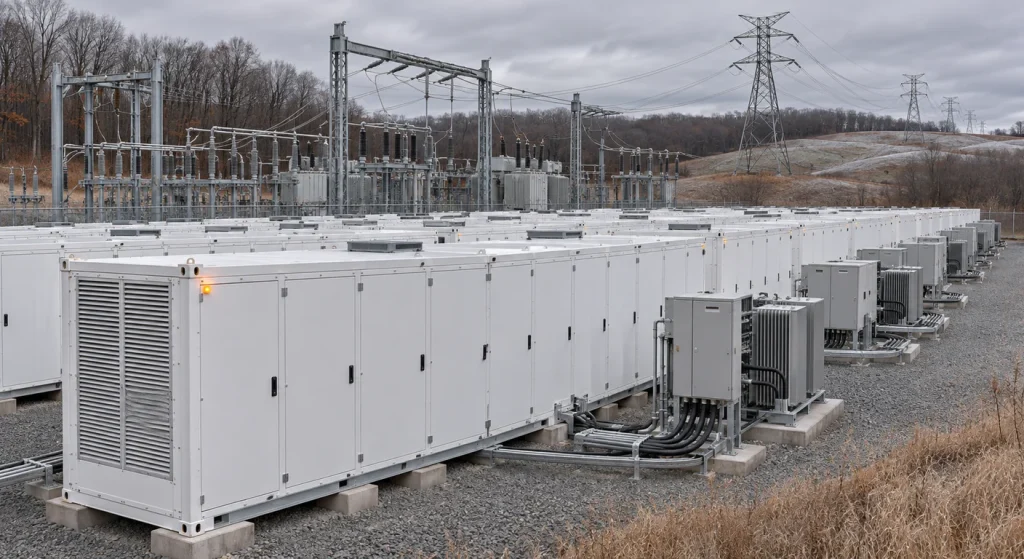
The project is Pittsgrove Storage, a four-hour lithium iron phosphate battery of up to 500 MW in Salem County. Its petition projects no incremental bill impact for roughly the first five years of operation and $1.36 of customer benefits per $1.00 invested, according to The Duck Curve.
Kleczynski said the Atlantic City Electric project would become the largest battery installation in the PJM Interconnection. He put its expected net benefits to customers at more than $700 million.
New Jersey, Maryland and Delaware allow Exelon utilities to own storage facilities to bolster grid resiliency, Kleczynski said. Those permissions provide a route for utility ownership in states where Exelon operates.
“With regulated storage, we have certainty that projects get built, and control over when and how they’re deployed,” Kleczynski said, according to Utility Dive.
Kleczynski also described utility-owned storage as an option alongside competitive development. He said Exelon views the ownership model as complementary to competitive projects.
PJM supply pressure and large loads
Exelon CEO Calvin Butler said PJM is moving too slowly to add generation. He called that pace the biggest issue facing consumers across the grid operator’s Mid-Atlantic and Midwest footprint, Utility Dive reported.
PJM’s backstop capacity procurement plan and Interim Resource Adequacy Service proposal have both faced delays following partial approvals from the Federal Energy Regulatory Commission.
Exelon’s high-probability large-load additions remained flat at 11 GW, the company said. That includes 9 GW in Commonwealth Edison’s northern Illinois service territory and 2 GW in the Mid-Atlantic.
Its future load pipeline slipped to 23 GW from 25 GW last quarter. The pipeline comprises 14 GW with ComEd and 9 GW in the Mid-Atlantic.
Why It Matters
Exelon is pursuing utility-owned storage alongside a substantial transmission spending plan. Its existing capital plan includes $16.3 billion for transmission through 2029, according to Utility Dive.
The company also sees $12 billion to $17 billion in transmission opportunities beyond that plan, including infrastructure for large loads. Storage adds another potential investment route as Exelon seeks faster generation additions in PJM.
For New Jersey customers, the immediate issue is the pending storage decision. Atlantic City Electric’s proposal puts utility ownership, deployment control and Exelon’s projected customer benefits before state regulators. Rate Counsel’s motion asks them to settle first whether the utility is allowed to own the battery at all.
Critical Perspective
Officials’ estimate of $3 billion to $7 billion in storage spending, reported by Utility Dive, describes potential projects rather than an approved construction pipeline. The New Jersey proposal faces a threshold ownership challenge from Rate Counsel, backed by PJM’s independent market monitor. Kleczynski’s claim of deployment certainty therefore runs ahead of a ruling on whether Atlantic City Electric can own this battery. How will Exelon revise the New Jersey proposal if regulators accept the dismissal motion?