Medium-Voltage to Low-Voltage DC Distribution Architecture Co-Design: Why the SST Choice Drives Everything Downstream

- Conventional MV-LV: 4-35 kVAC u2192 iron-core step-down u2192 277-480 VAC secondary u2192 downstream conversion at load
- 800 VDC architecture (NVIDIA AI Factory): SST u2192 800 VDC busway u2192 50 VDC at accelerator rack shelf
- 1500 VDC architecture (utility solar): SST u2192 1500 VDC string u2192 central/string inverter to AC
- 800 and 1500 VDC ecosystems not interchangeable — switchgear, protection, conversion all voltage-specific
- Bundled SST+downstream integration vs component cost-per-kW: divergent commercial strategies through 2026-2028
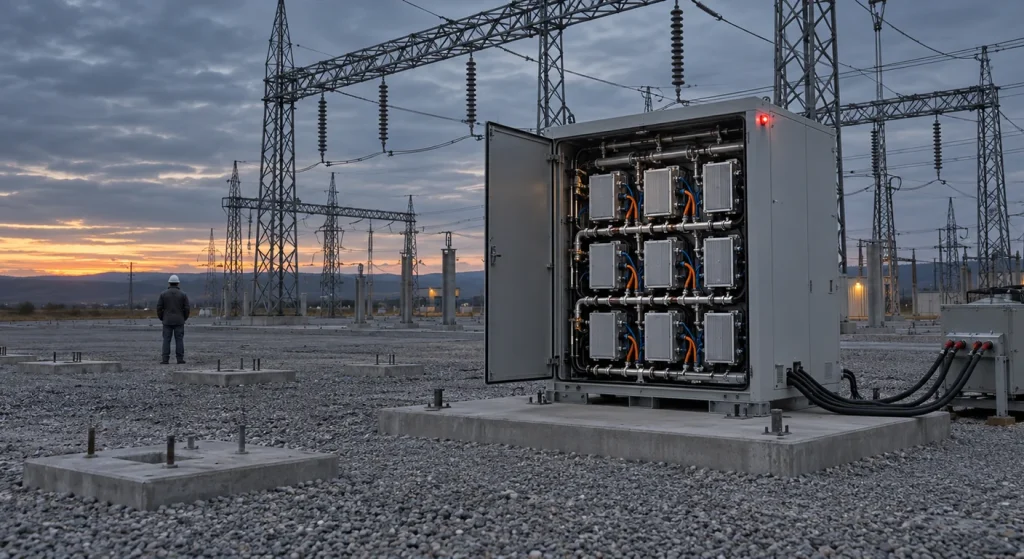
The conventional medium-voltage-to-low-voltage (MV-LV) distribution architecture in a US commercial or industrial facility has been broadly standardized for fifty years: utility input at 4 to 35 kilovolts AC, an iron-core step-down transformer, secondary AC distribution at 277 to 480 volts, and downstream conversion at the load. The 800-volt DC distribution architecture that has emerged for AI data centers and that is spreading into adjacent applications inverts this pattern. The solid-state transformer (SST) at the MV-LV boundary is not merely a replacement for the iron-core transformer; it is the controlling design choice that dictates every downstream conversion stage.
The system co-design question is: at what voltages should DC power be distributed within a facility, and at what voltage should final conversion to load levels occur? The 800-volt DC NVIDIA AI Factory specification answers this for the AI-accelerator case: 800 VDC at the facility distribution level, 50 VDC at the rack power-shelf input to the accelerator card. The 1500-volt DC utility-scale solar standard answers it differently: 1500 VDC at the array string level, with central or string-inverter conversion to grid-compatible AC.
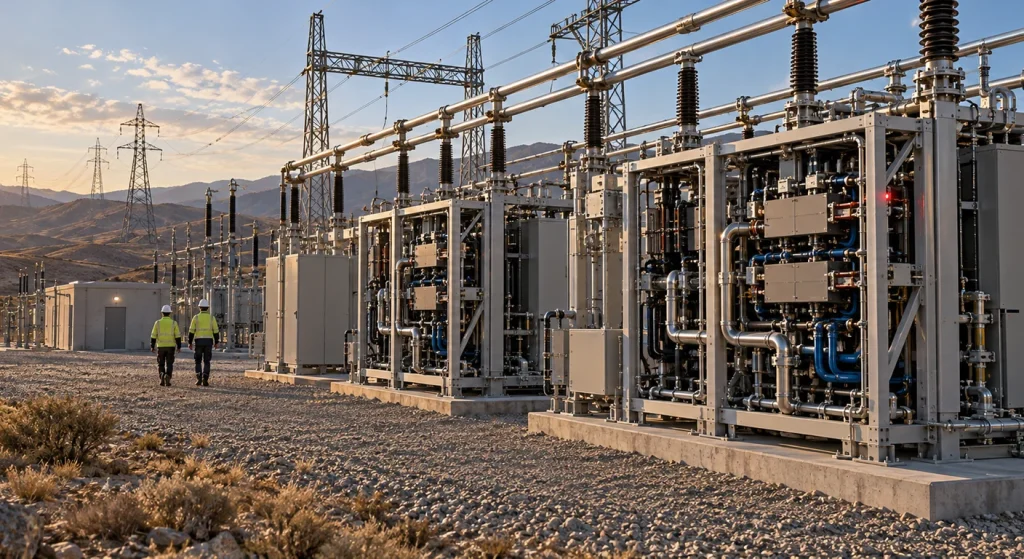
The co-design implication is that the SST output voltage choice determines the design of every downstream component. An 800-volt DC SST output drives a corresponding 800-volt DC busway, 800-volt DC switchgear, 800-volt DC protective relaying, and 800-volt DC rack power shelves. A 1500-volt DC SST output drives a different ecosystem of switchgear, protection, and conversion. The two ecosystems are not interchangeable. Equipment optimized for 800 VDC is not directly usable in a 1500 VDC system and vice versa, even when the underlying semiconductor devices are the same.
The supply-chain alignment around the two voltage classes is becoming visible. Switchgear manufacturers Schneider Electric, Eaton, ABB, and Siemens have each announced 800 VDC product lines through 2025 and 2026. Pre-existing 1500 VDC product lines from these same suppliers serve the utility-scale solar market and are being expanded to serve adjacent applications. Cable, conductor, and protective-device manufacturers (Cooper, Mersen, Littelfuse) face similar dual-architecture pressure.
The co-design discipline that produces the best total-system cost-per-megawatt result is materially different from the discipline that produces the best component-level cost-per-kilowatt result. SST manufacturers selling against utility procurement RFPs that specify component-level cost benchmarks risk losing market position to competitors that bundle the SST with downstream switchgear, protective relaying, and integration services. The Eaton-Resilient product line, the DG Matrix multi-port architecture, the SolarEdge-Infineon convergent 800-1500 VDC platform, and the Heron Power Heron Link product are each in different positions on the integration-vs-component-cost spectrum. Where the market converges by 2028 is the open commercial question.
Why It Matters
For facility electrical designers, the 800V DC architecture spreading from AI data centers inverts fifty years of MV-to-LV convention and makes the SST the pivot point that determines the entire downstream distribution design. Choosing an SST is therefore not a like-for-like transformer swap; it commits the facility to a DC distribution topology, so the decision has to be made at the architecture stage, not at equipment procurement.
Critical Perspective
Editorial correction: This post is part of MGRID’s Solid-State Transformer industry coverage. As of May 2026, that body of work systematically framed manufacturer announcements, funding rounds, and laboratory demonstrations as commercial deployments. The reality is that field-deployed commercial-class SST in revenue service globally is measured in single digits, and almost every product cited in this series is at “announced” or “funded” stage, not “operational.” Readers should treat the specific claims in this post against the standards documented in our SST Industry Reality Check (the per-claim audit table maps marketing language to verifiable deployment status). The corrective article is the canonical reference for SST industry reality; this post remains published with its original framing so the editorial drift is traceable.
Related Coverage
Bundled SST+downstream integration vs component cost-per-kW: divergent commercial strategies through 2026-2028