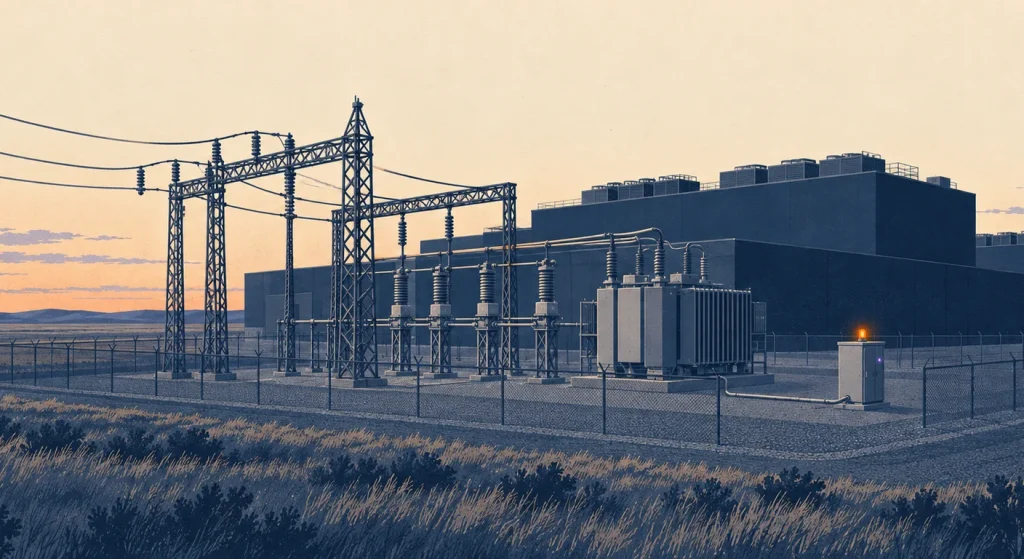
Army Corps Breaks Ground on $11.6 Million Rock Island Arsenal Substation Anchoring a 14 MW Microgrid
- Industrial & C&I Microgrids Microgrids News
Marin Holt
- 0
- 7 minutes read
- Substation cost: $11.6 million
- Microgrid generation: 14 MW
- ERCIP project value: $67 million
- Battery storage: 400 kW / 1.6 MWh
- Groundbreaking: June 12, 2026
The U.S. Army Corps of Engineers broke ground on June 12, 2026, on an $11.6 million electrical substation at Rock Island Arsenal in Illinois, the first piece of a wider modernization that pairs the installation with a planned 14 MW microgrid to keep its weapons-manufacturing complex running through grid outages.
The new substation replaces a primary unit installed in 1975 and steps power down at roughly 70 kV for the arsenal’s distribution network. The Louisville District, supported by the Rock Island District, is running the design-bid-build job, which is scheduled for completion in November 2027 and handover in May 2028. The scope integrates back-up generation so the Joint Manufacturing and Technology Center (JMTC), the Army’s organic arsenal for armor and battlefield logistics hardware, holds a stable power baseline.
A substation feeding a larger microgrid
The substation is being built alongside a separate $67 million Energy Resilience and Conservation Investment Program (ERCIP) project that gives Rock Island Arsenal a true islanding microgrid. That system combines 14 MW of natural-gas reciprocating engines, 3 MW of solar, and a 400 kW / 1.6 MWh battery with the arsenal’s existing 2.8 MW hydroelectric plant on the Mississippi River. When the commercial grid drops, the microgrid is designed to carry the entire arsenal distribution system on its own.
“This project sets the stage for a comprehensive upgrade of our electrical facilities,” said Col. Joe Parker, the Rock Island Arsenal commander. Louisville District Commander Col. L. Reyn Mann described the work as “delivering mission assurance,” while project manager Eric Cheng said the goal was “a secure, reliable electrical power baseline.”
What the Resilience Math Shows
The microgrid stacks 14 MW of natural-gas reciprocating engines, 3 MW of solar, a 400 kW battery and the arsenal’s existing 2.8 MW hydroelectric plant, about 20 MW of on-site resources against a 14 MW islanding target. That leaves headroom to carry the manufacturing load when the commercial grid drops rather than running the resources flat out. The $11.6 million substation is roughly one-sixth of the separate $67 million resilience program, and it replaces a primary unit installed in 1975, so the rebuild clears a half-century-old single point of failure before the islanding layer arrives. The phasing is deliberate: the substation reaches completion in November 2027 with handover in May 2028, so the conventional reliability fix lands first and the full islanding capability follows.
Critical Perspective
The $11.6 million substation and the $67 million islanding microgrid are funded and scheduled as separate projects, and only the substation carries a public timeline: completion in November 2027 and handover in May 2028. The microgrid that actually delivers islanding has no stated completion date, so the resilience the program promises arrives on an open-ended schedule. The islanding design also leans heavily on fuel. The 14 MW of natural-gas reciprocating engines dwarf the 3 MW of solar, the 2.8 MW hydroelectric plant, and a 400 kW / 1.6 MWh battery that holds only minutes at full load, so during a prolonged outage the arsenal’s ride-through depends on gas deliveries rather than the solar-and-storage layer the project highlights. If the substation finishes in 2027 but the microgrid slips, how long does Rock Island run on a rebuilt substation with no islanding capability behind it?
Why It Matters
Defense installations are increasingly treated as critical loads that must not go dark for hours, and the Army has used the ERCIP program to push fixed-scope microgrids onto its manufacturing arsenals. Rock Island shows the pattern: a conventional substation rebuild handles day-to-day reliability, while a parallel gas, solar, storage and hydro microgrid provides the islanding capability. For contractors and equipment suppliers, the split signals where federal microgrid dollars are flowing: toward installations that build materiel, not just house troops.
Sources
- DVIDS / U.S. Army — USACE Louisville District breaks ground on $11.6M Rock Island Arsenal substation
- USACE Huntsville Center — Energy program leads path for $67 million Rock Island Arsenal project
- America’s Engineers — $67 million Rock Island Arsenal microgrid project
- SAM.gov — Construction of Rock Island Arsenal Microgrid (USACE Louisville District)