Global Market Insights Reports on Ultra-Fast EV Charging
- Analysis Megawatt Charging & Power Conversion Power Electronics
Marin Holt
- 0
- 6 minutes read
- Market size projection: $15 billion by 2027
- Charging power: 350–400 kW
- Charging time: ~20 minutes full charge
- Key assumption: Widespread 800 V EV architecture adoption
- Source: Global Market Insights report
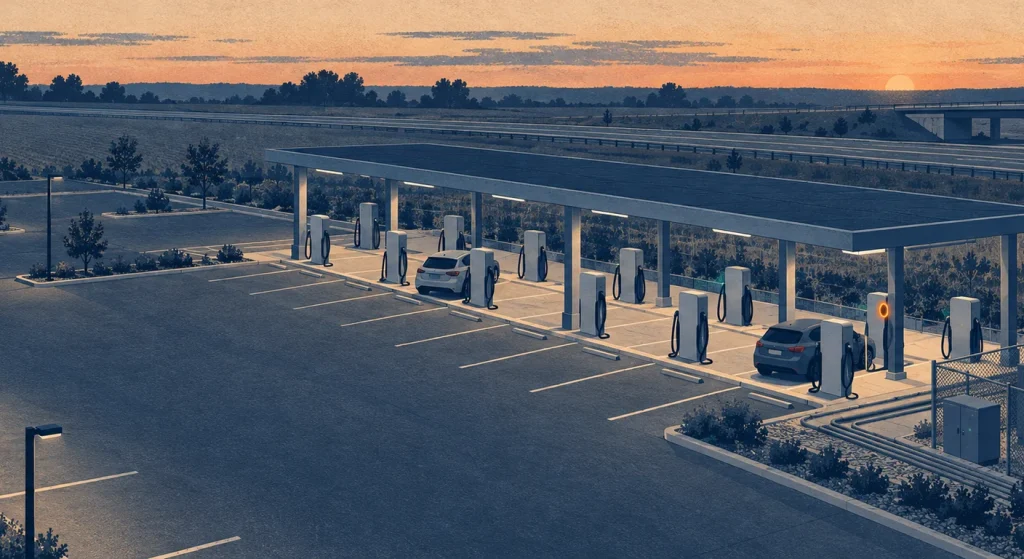
**Opening Paragraph** Global Market Insights projects the ultra-fast EV charging systems market, specifically the 350 kW to 400 kW segment, will reach $15 billion by 2027, a figure that hinges on the unproven assumption that widespread adoption of 800 V EV architectures will materialize as anticipated. These high-power units, capable of an 80% charge in under 20 minutes, are reportedly gaining traction in the United States, particularly in California, as of January 2025, though the exact cost, potentially running into millions of dollars per installation, remains subject to specific implement
Global Market Insights claims fast EV charging is crucial for widespread adoption. They argue quick charging tackles range anxiety and boosts consumer appeal. The report projects the ultra fast EV charging systems market will reach $15 billion by 2027, according to their analysis. The 350 kW to 400 kW systems are particularly well-suited for use with 800 V EV architectures, which are becoming increasingly common in new electric vehicle models. This compatibility is expected to drive growth in the ultra-fast charging market, as more vehicles are able to take advantage of the faster charging speeds. The report notes that the ultra-fast charging market is expected to experience significant growth in the coming years, driven by increasing demand for electric vehicles and government initiatives to support the development of high-power charging infrastructure.
The ultra-fast charging systems market is also expected to be driven by the growing demand for high-power charging in areas with high electric vehicle adoption rates. California, in particular, is seen as a key market for ultra-fast charging systems, with many companies already investing in the development of high-power charging infrastructure in the state. The report from Global Market Insights notes that the cost of ultra-fast charging systems is expected to decrease over time, making them more competitive with traditional charging methods. This is expected to drive further growth in the market, as more companies and governments invest in the development of high-power charging infrastructure. The report highlights the importance of standardization and interoperability in the ultra-fast charging market, to ensure that vehicles from different manufacturers can charge at any high-power charging station.
Why It Matters
The growth of the ultra-fast EV charging systems market has significant implications for the development of the US electric vehicle charging infrastructure. As more vehicles become capable of using high-power charging, the demand for ultra-fast charging systems is expected to increase, driving investment in the development of new charging infrastructure. This, in turn, is expected to support the widespread adoption of electric vehicles, reducing greenhouse gas emissions and improving air quality in urban areas. The development of ultra-fast charging infrastructure is also expected to have a positive impact on the US economy, creating jobs and driving investment in the energy and transportation sectors.
Sources
https://www.gminsights.com/industry-analysis/ultra-fast-ev-charging-systems-market – Global Market Insights
https://www.gminsights.com/industry-analysis/ultra-fast-ev-charging-systems-market – www.gminsights.com
Critical Perspective
Series context: This post is part of MGRID’s Megawatt Charging System (MCS) industry coverage. The MCS spec was ratified by CharIN in 2023 and SAE in early 2024, and the 18 months since have produced a steady wave of vendor announcements, fleet pilots, and lab demonstrations. Readers should distinguish three distinct claim tiers in MCS coverage: (1) spec compliance, which most products credibly claim because the spec is settled; (2) production shipments, which reduces to ABB MCS1200 plus a handful of pre-production units from other vendors as of mid-2026; and (3) field-deployed truck refuels at MCS-rated power, which is measured in single digits globally. Coverage that conflates these tiers overstates commercial maturity. Field availability of MCS-spec chargers will scale through 2027 as Heliox, Kempower, ChargePoint, Tritium, and others move past prototype builds. For each product cited in this post, readers should verify the deployment tier (lab / pilot / commercial pilot / general availability) before assuming operational readiness.