Solid-State Transformers Integrate Battery Storage Through Multiport Architectures: NREL’s Dispatch and Control Research

- Multiport SSTs interface MV utility + BESS DC bus + facility loads from a single chassis
- NREL 2022 study: SST+BESS hosts more distributed PV, delivers peak shaving, voltage regulation, reverse-power mitigation
- Hybrid transformer (HT): iron-core transformer + 10-30% rated converter — lower-cost partial-functionality alternative
- DG Matrix multiport, Heron Power roadmap, Eaton Resilient line all explicitly target BESS integration
- Distribution-class SST+BESS could displace voltage regulators, capacitor banks, LTC transformers
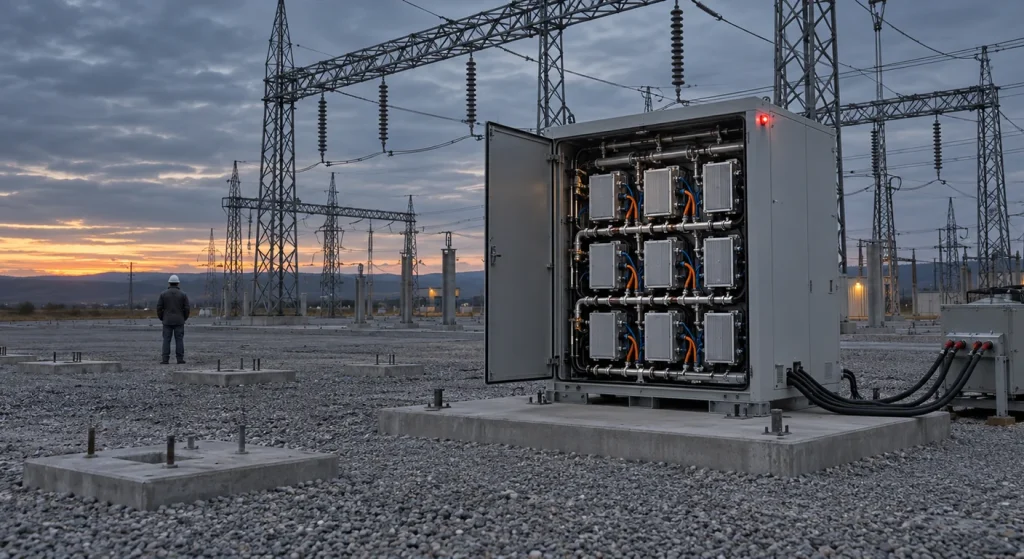
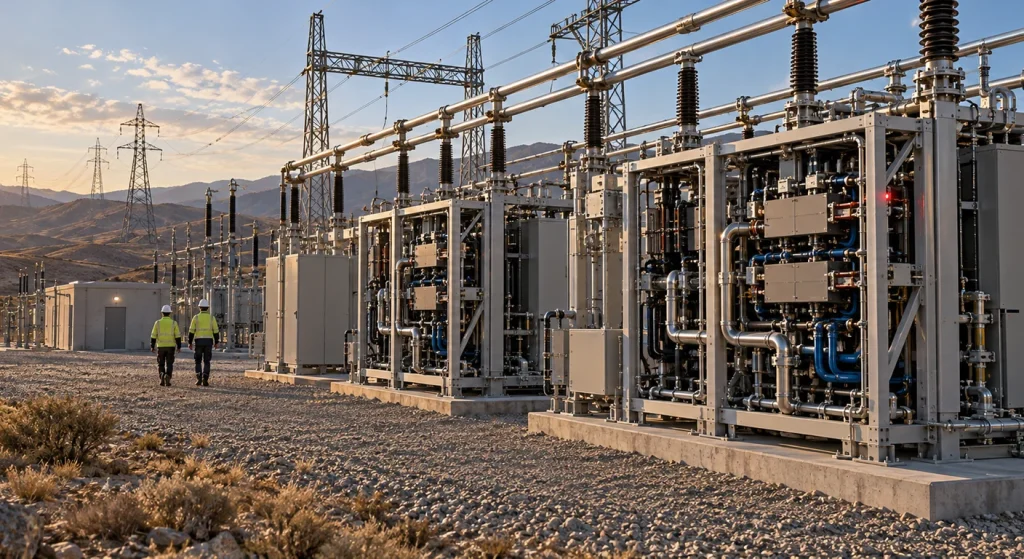
The integration of battery energy storage systems (BESS) with solid-state transformers (SSTs) is one of the most commercially active application patterns emerging from the SST industry. The architectural pattern — a multiport SST that simultaneously interfaces medium-voltage utility power, a battery storage DC bus, and one or more facility AC or DC loads from a single chassis — is a meaningful capability extension over conventional iron-core distribution transformers, which cannot interface a battery at all without auxiliary power-conversion equipment.
The National Renewable Energy Laboratory (NREL) published a 2022 technical-economic comparison of SST and hybrid transformer (HT) architectures with integrated BESS in active distribution grids. The study found that SST and HT units with integrated storage can host more distributed photovoltaic generation, deliver peak-shaving services, mitigate voltage fluctuation and reverse power flow on distribution feeders, and support energy arbitrage compared to conventional transformers. The economic comparison favored SST/HT-plus-storage in scenarios with high distributed-PV penetration and time-of-use tariff structures.
The hybrid transformer architecture is worth distinguishing from the full SST architecture. A hybrid transformer combines a conventional iron-core transformer with a partially-rated power-electronics converter — typically 10 to 30 percent of the full transformer rating — that handles voltage regulation, reactive-power compensation, and limited BESS integration. The HT cost-per-kVA premium over a conventional transformer is significantly smaller than the full-SST premium. For applications where the SST’s full-rating active control is not required, the hybrid transformer can deliver substantial fraction of the value at substantially lower cost.
The commercial implication is visible in the product roadmaps of multiple SST manufacturers. DG Matrix’s multi-port SST explicitly includes a BESS port in the architecture. Heron Power’s Heron Link product, while targeted at AI data center applications today, has BESS integration on its disclosed longer-term roadmap. Eaton’s Resilient Power-derived product line addresses BESS interconnect as one of four named application targets.
The grid-edge voltage control problem that an SST plus BESS combination can solve is consequential for utility distribution-system operators. Decentralized grid-model-less voltage control methods and day-ahead BESS dispatch algorithms have been the subject of substantial research at NREL, the University of Texas, and other US institutions. The technical case for distribution-class SSTs to displace voltage regulators, capacitor banks, and load-tap-changing transformers at problem distribution feeders is plausible. Whether the commercial cost equation supports that displacement is the question utilities are asking now and the question SST manufacturers are answering through 2026 and 2027.
Why It Matters
The integration of battery energy storage systems (BESS) with solid-state transformers (SSTs) has significant implications for the US utility industry, particularly in regions with high distributed photovoltaic generation penetration, such as those managed by ERCOT, PJM, and CAISO operators. As data-center demand continues to grow, the ability of SSTs to host more distributed generation and provide peak-shaving services will be crucial in managing grid stability.
The economic benefits of SST and hybrid transformer architectures with integrated BESS, as highlighted by NREL’s technical-economic comparison, will likely influence FERC orders and IEEE/NERC standards in the future. The potential for SSTs to displace traditional voltage regulators, capacitor banks, and load-tap-changing transformers at problem distribution feeders is a key area of research, with substantial cost savings and grid resilience benefits at stake.
As SST manufacturers continue to develop their product roadmaps, the commercial viability of these solutions will be closely watched by utilities and grid operators. With companies like DG Matrix, Heron Power, and Eaton already incorporating BESS integration into their products, the market is poised for significant growth and innovation in the coming years.
Critical Perspective
Editorial correction: This post is part of MGRID’s Solid-State Transformer industry coverage. As of May 2026, that body of work systematically framed manufacturer announcements, funding rounds, and laboratory demonstrations as commercial deployments. The reality is that field-deployed commercial-class SST in revenue service globally is measured in single digits, and almost every product cited in this series is at “announced” or “funded” stage, not “operational.” Readers should treat the specific claims in this post against the standards documented in our [SST Industry Reality Check](/?p=9044) (the per-claim audit table maps marketing language to verifiable deployment status). The corrective article is the canonical reference for SST industry reality; this post remains published with its original framing so the editorial drift is traceable.
Related Coverage
Distribution-class SST+BESS could displace voltage regulators, capacitor banks, LTC transformers