EPRI and Six Major US Utilities Are Demonstrating an All-Solid-State 25 kVA Pole-Mount Transformer From Solid State Power

- EPRI managing program with 6 US utilities: Xcel, ConEdison, AEP, Southern Company, SCE, NYPA
- Solid State Power Inc. (SSP) unit: outdoor-rated, pole-mounted, 1-phase 25 kVA
- Electrical: 7.2 kV AC primary, split 2 x 120 V AC secondary — direct 1:1 replacement for conventional distribution unit
- ~80 million 25 kVA distribution transformers installed across US
- Counterweight to AI-data-center SST narrative — focuses on residential-serving mass volume + decades reliability
The Electric Power Research Institute (EPRI) is managing an active demonstration program with six of the largest US utilities to evaluate an all-solid-state, pole-mount, single-phase 25 kilovolt-ampere distribution transformer manufactured by Solid State Power Inc. (SSP). The participating utilities are Xcel Energy, Consolidated Edison (ConEdison), American Electric Power (AEP), Southern Company, Southern California Edison (SCE), and the New York Power Authority (NYPA). The program is one of the most consequential utility-level field validations of solid-state transformer (SST) technology in active execution.
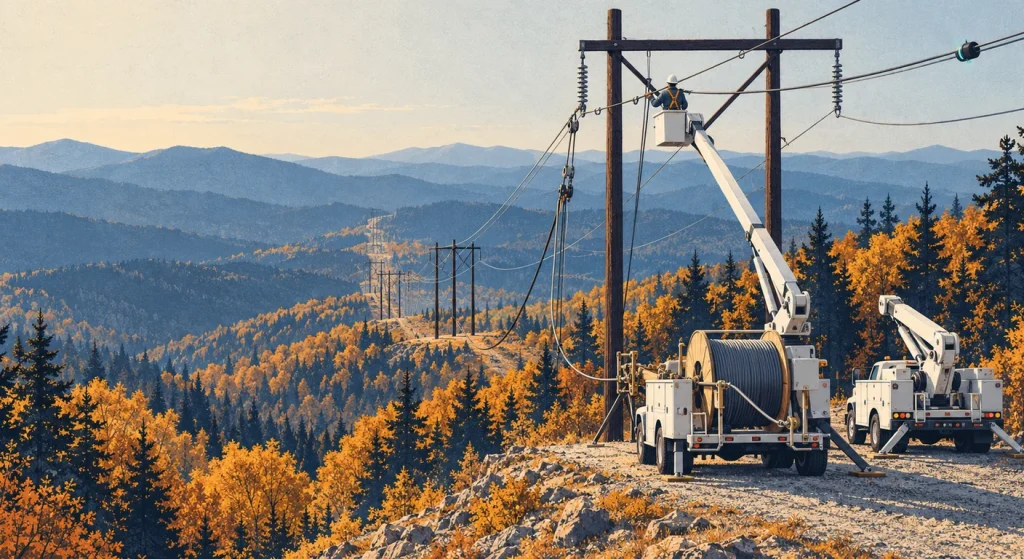
The SSP SST under demonstration is an outdoor-rated, pole-mounted, single-phase unit rated at 25 kVA, with 7.2 kilovolt AC primary input and split 2 x 120 volt AC secondary output. The form factor and electrical interface are designed for direct one-to-one replacement of conventional 25 kVA distribution transformers — the workhorse units used to serve residential and small-commercial loads across US suburban and urban distribution networks. There are roughly 80 million such units installed across the United States.
The program objectives are straightforward but demanding. EPRI and the participating utilities are evaluating field reliability, harmonic performance against IEEE 519-2022, voltage regulation under unbalanced loads, fault-current response and protective coordination, and total cost of ownership over a multi-year deployment cycle. The 25 kVA single-phase pole-mount class is the volume segment of the US distribution transformer fleet, and is also the segment where the conventional iron-core transformer is hardest to displace on cost.
The program is notable as a counterweight to the AI-data-center-driven SST narrative that has dominated trade press through 2025 and 2026. The data center SST conversation focuses on multi-megawatt medium-voltage units feeding 800-volt DC AI accelerator racks. EPRI’s SSP demonstration focuses on the opposite end of the application spectrum: small, mass-volume, residential-serving units where reliability over decades and cost per kVA are the deciding factors.
If the SSP unit performs to specification across the six participating utilities, the technical case for SST replacement of conventional distribution transformers at the 25 kVA class becomes credible. Whether the cost-per-kVA case becomes credible is the harder question. Pole-mount distribution transformers are manufactured at margins so thin that any cost premium from SST architectures has historically been disqualifying. The program will not resolve the cost question on its own but will produce the field-reliability data that is the necessary input.
Why It Matters
For distribution engineers, an EPRI field program running SSP’s 25 kVA pole-mount SST across Xcel, ConEd, AEP, Southern, SCE, and NYPA is the closest thing to a real utility validation the technology has, because it puts hardware on live feeders instead of in a lab. The six-utility spread matters: consistent field data across different climates and grid conditions is what utility standards bodies need before writing SSTs into procurement specs.
Critical Perspective
Editorial correction: This post is part of MGRID’s Solid-State Transformer industry coverage. As of May 2026, that body of work systematically framed manufacturer announcements, funding rounds, and laboratory demonstrations as commercial deployments. The reality is that field-deployed commercial-class SST in revenue service globally is measured in single digits, and almost every product cited in this series is at “announced” or “funded” stage, not “operational.” Readers should treat the specific claims in this post against the standards documented in our [SST Industry Reality Check](/?p=9044) (the per-claim audit table maps marketing language to verifiable deployment status). The corrective article is the canonical reference for SST industry reality; this post remains published with its original framing so the editorial drift is traceable.