China State Grid Has Operated Demonstration Solid-State Transformer

- Qinghai Province 110 kV SST commissioned 2019 by China Electric Power Research Institute for wind integration
- Wujiang MVDC/LVDC project: u00b110 kV/750 V 2 MW SST in Jiangsu
- Hangzhou Dajiangdong: u00b110 kV/u00b1375 V 500 kW SST in Zhejiang
- Major Chinese SST suppliers: State Grid manufacturing arm, TBEA, Sieyuan Electric, XJ Electric
- Combined Chinese SST manufacturing capacity estimated > combined Eaton+Hitachi+ABB+Delta capacity in MW/yr
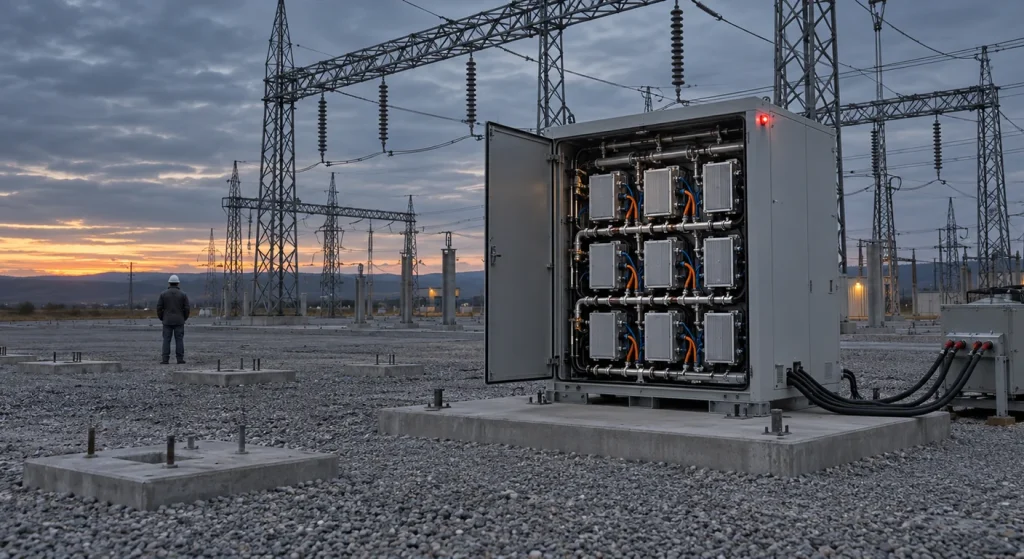
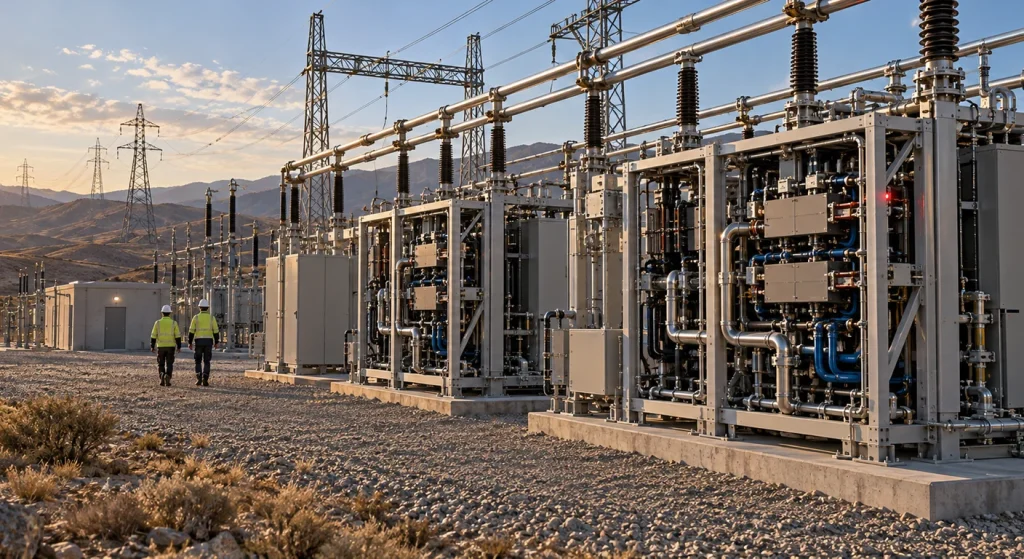
The State Grid Corporation of China has operated solid-state transformer (SST) demonstration projects at higher voltage classes and at larger volumes than any utility in the United States or Europe. The aggregate Chinese SST deployment portfolio includes a 110-kilovolt SST in Qinghai Province for wind-power integration (commissioned 2019 by the China Electric Power Research Institute), a 35-kilovolt SST for urban distribution applications, and a 10-kilovolt SST for renewable-integration applications. The volume and voltage range of Chinese SST deployments significantly exceeds Western utility deployment volume.
The Wujiang MVDC and LVDC Power Distribution System Demonstration Project, located in Jiangsu Province, features a plus/minus 10-kilovolt to 750-volt 2-megawatt SST as the medium-voltage-to-low-voltage interface. The Hangzhou Dajiangdong DC Distribution Network Demonstration Project, located in Zhejiang Province, features a plus/minus 10-kilovolt to plus/minus 375-volt 500-kilowatt SST. Both projects predate the equivalent Western utility-scale MVDC-distribution demonstrations and produce field operational data the Chinese power-industry research community has used to refine subsequent designs.
The Qinghai 110-kilovolt SST installation is the highest-voltage operational SST publicly documented anywhere in the world. The Qinghai installation was driven by the wind-integration challenges of the Qinghai-Tibetan Plateau region where high wind potential is coupled with weak grid infrastructure. The SST’s active power-quality features (voltage regulation, harmonic suppression, reactive-power compensation) addressed the specific weak-grid challenges that conventional iron-core transformers handle poorly.
The Chinese SST industrial base is also more diversified than is typically recognized in Western trade-press coverage. Major Chinese SST suppliers include China State Grid’s own equipment manufacturing arm, TBEA, Sieyuan Electric, XJ Electric, and several smaller specialists. The combined Chinese SST manufacturing capacity is not publicly enumerated but is estimated by industry analysts to exceed the combined capacity of Eaton, Hitachi Energy, ABB, and Delta Electronics measured in megawatts per year. The export-market potential for Chinese SST products into Southeast Asia, Africa, and Latin America is the strategic concern Western SST manufacturers are now beginning to address.
The information asymmetry between Chinese and Western SST industries is significant. State Grid Corporation of China operational data on SST field reliability, harmonic performance, and lifecycle cost is largely not published in Western IEEE journals or trade-press outlets. Whether the Chinese SST industry has solved the multi-decade reliability question that Western utilities are still benchmarking against the EPRI-SSP 25 kVA demonstration program — or whether the operational data simply has not been shared — is the open intelligence question.
Why It Matters
For anyone benchmarking Western progress, China State Grid has operated SST demonstrations at 110 kV and at volumes no US or European utility approaches, including a 2019 wind-integration unit in Qinghai. The gap is a strategic signal: the technology’s field-reliability questions are being answered first in China, which shapes both the supply chain and the standards conversation that Western utilities will eventually inherit.
Critical Perspective
Editorial correction: This post is part of MGRID’s Solid-State Transformer industry coverage. As of May 2026, that body of work systematically framed manufacturer announcements, funding rounds, and laboratory demonstrations as commercial deployments. The reality is that field-deployed commercial-class SST in revenue service globally is measured in single digits, and almost every product cited in this series is at “announced” or “funded” stage, not “operational.” Readers should treat the specific claims in this post against the standards documented in our [SST Industry Reality Check](/?p=9044) (the per-claim audit table maps marketing language to verifiable deployment status). The corrective article is the canonical reference for SST industry reality; this post remains published with its original framing so the editorial drift is traceable.