Solid-State Transformer Lifecycle Carbon: 30 Percent Lower Manufacturing Emissions Plus Substantially Lower Operational Losses

- SST manufacturing emissions ~25 tonnes CO2e per unit — ~30% lower than iron-core baseline
- Operational losses dominate lifecycle GHG: >96% of total transformer emissions
- Conventional 100 kVA distribution transformer: 22.9 tonnes CO2/yr operational, ~572 tonnes over 25 years
- SST lifetime emissions advantage estimated 10-25% over 25-year horizon at typical partial-load profiles
- End-of-life: SST ~5 tonnes vs iron-core 5-10 tonnes — SST recycling infrastructure not yet mature
Life-cycle assessment (LCA) studies comparing solid-state transformers (SSTs) against conventional iron-core distribution transformers at equivalent kVA ratings show two structural advantages for the SST architecture and one significant disadvantage. The manufacturing-phase carbon footprint of an SST is approximately 30 percent lower than the iron-core baseline. The operational-phase loss profile favors SSTs at variable or partial load. The end-of-life recyclability gap, however, partially offsets the operational-phase advantage. The aggregate lifecycle carbon comparison is favorable for SSTs in most scenarios but not by as wide a margin as the operational-efficiency comparison alone would suggest.
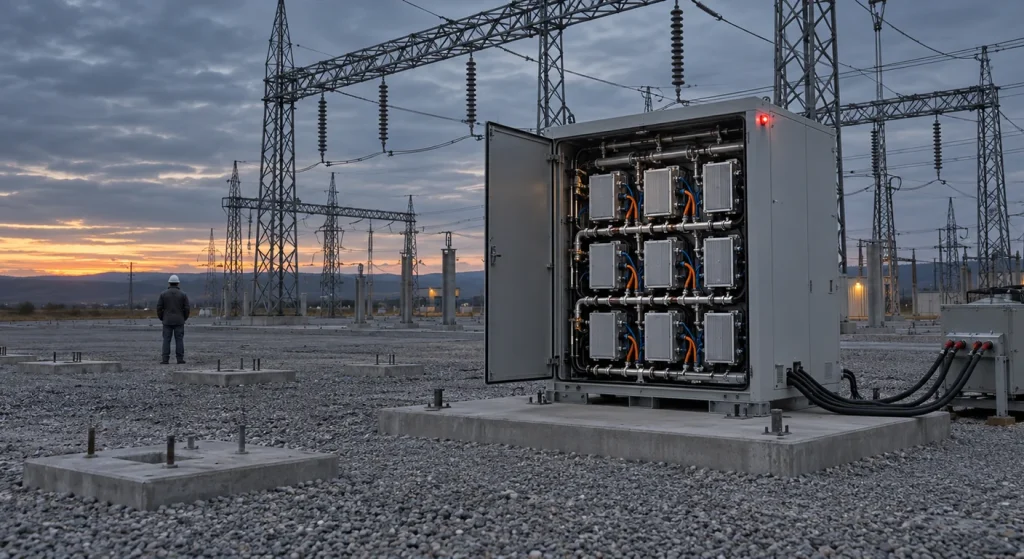
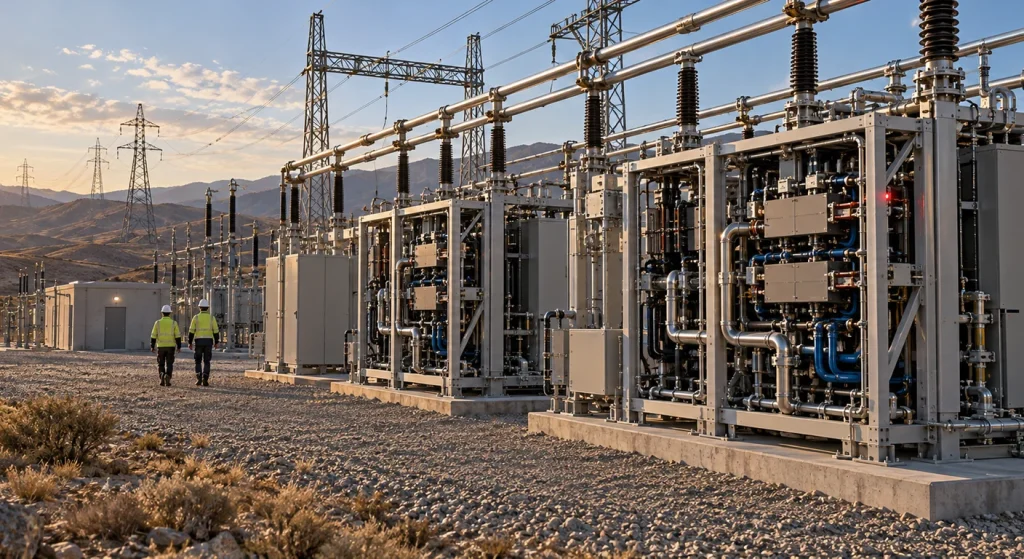
The manufacturing-phase comparison is concrete. An SST requires substantially less metal mass per kVA than an iron-core transformer because the SST’s medium-frequency transformer operates at 5 to 30 kilohertz rather than 50 to 60 hertz, reducing the magnetic-core mass requirement by approximately an order of magnitude. SST manufacturing also benefits from automated modular production methods compared to the partially manual winding and assembly process for conventional iron-core transformers. Published LCA studies estimate SST manufacturing emissions at approximately 25 tonnes of carbon dioxide equivalent per typical commercial unit, about 30 percent lower than the iron-core equivalent.
The operational-phase comparison dominates the lifecycle picture. Operational electrical losses contribute more than 96 percent of total transformer lifecycle GHG emissions according to multiple LCA studies. A conventional 100-kVA distribution transformer with 1.1 kilowatts of idle losses plus 5.4 kilowatts of full-load copper losses produces approximately 57,240 kilowatt-hours of energy losses per year, equivalent to about 22.9 tonnes of carbon dioxide annually under typical US grid emissions factors. Over the 25-year service lifetime, the cumulative emissions reach approximately 572 tonnes.
SST operational losses depend substantially on the load profile. At full-load operation, SSTs land in the 96-to-99 percent efficiency range compared to the iron-core 98-to-99 percent range. At partial load (the realistic operating point for most distribution transformers, which spend the majority of their service life below 50 percent rated load), the SST’s ability to actively manage switching losses produces a meaningful operational efficiency advantage. The lifetime cumulative emissions advantage for SSTs at typical partial-load profiles is estimated at 10 to 25 percent over the 25-year service horizon.
The end-of-life phase is where the SST faces its primary GHG disadvantage. SST end-of-life emissions are estimated at approximately 5 tonnes of carbon dioxide equivalent, similar to or slightly lower than the iron-core baseline of 5 to 10 tonnes. The qualitative challenge is that the SST’s lower-mass-but-higher-complexity construction makes recovery of valuable components (silicon carbide modules, nanocrystalline-core MFTs, MPPF capacitors) much more difficult than recovery of iron-core transformer copper and silicon-steel. Whether the recycling infrastructure for SST end-of-life components matures by the time the first commercial SST products reach the end of their service life (approximately 2045 for 2020-era pilot deployments) will determine whether this offset closes.
Why It Matters
For sustainability and procurement teams, life-cycle assessments give the SST roughly 30 percent lower manufacturing carbon and better partial-load operating losses, offset by a worse end-of-life recyclability gap versus iron-core units. The net environmental case is therefore real but conditional, and it depends on operating profile, so buyers claiming an SST is greener need the load data to back it rather than treating the manufacturing figure alone as the whole story.
Critical Perspective
Editorial correction: This post is part of MGRID’s Solid-State Transformer industry coverage. As of May 2026, that body of work systematically framed manufacturer announcements, funding rounds, and laboratory demonstrations as commercial deployments. The reality is that field-deployed commercial-class SST in revenue service globally is measured in single digits, and almost every product cited in this series is at “announced” or “funded” stage, not “operational.” Readers should treat the specific claims in this post against the standards documented in our SST Industry Reality Check (the per-claim audit table maps marketing language to verifiable deployment status). The corrective article is the canonical reference for SST industry reality; this post remains published with its original framing so the editorial drift is traceable.
Related Coverage
End-of-life: SST ~5 tonnes vs iron-core 5-10 tonnes — SST recycling infrastructure not yet mature